
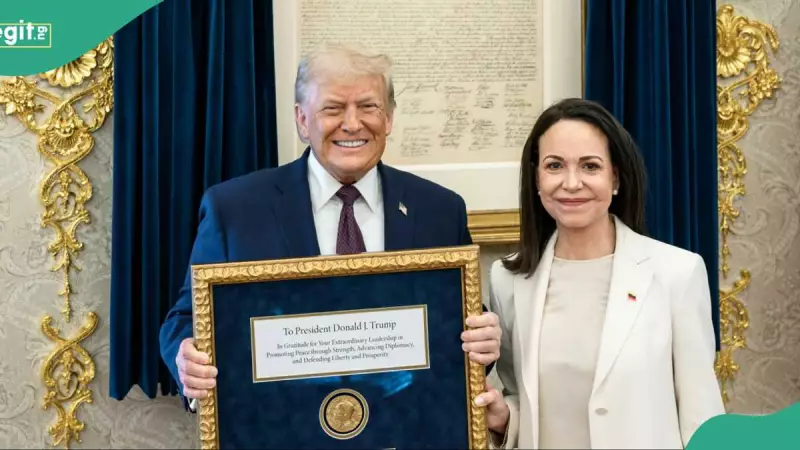
In a significant diplomatic encounter, former U.S. President Donald Trump accepted a Nobel Peace Prize medal from Venezuelan opposition leader Maria Corina Machado during a meeting at the White House. The event, which took place on January 16, 2026, brought Venezuela's turbulent political future back into sharp focus in Washington.
A Symbolic Gesture in the Oval Office
The face-to-face meeting between Trump and Machado lasted just over an hour. Machado, who fled Venezuela in December via a daring sea escape, presented her Nobel medal to the former president as a token of her gratitude. She described it as appreciation for what she called Trump's commitment to the freedom of the Venezuelan people.
A White House official confirmed that Trump intended to keep the physical medal, which was displayed in a gold-coloured frame. However, the Nobel honour itself legally remains with Machado, as the Norwegian Nobel Institute states the prize cannot be transferred or shared. Trump later acknowledged the gesture on social media, calling it a "wonderful gesture of mutual respect."
Competing Visions for Venezuela's Future
The meeting underscored starkly different priorities for the South American nation's path forward. White House press secretary Karoline Leavitt stated that while Trump looked forward to the meeting, he held a "realistic" view that Machado currently lacks the political support needed to govern Venezuela in the short term.
Instead, Trump's clear priority is securing U.S. access to Venezuela's vast oil reserves and rebuilding the country's shattered economy. He has publicly praised interim President Delcy Rodriguez, who took over after the capture of Nicolas Maduro, stating "She's been very good to deal with." Rodriguez has signalled plans to open Venezuela's oil sector to more foreign investment.
Political Reactions and Uncertain Democratic Path
Following her White House visit, Machado met with more than a dozen Republican and Democratic senators on Capitol Hill, where she found broader sympathy. However, Democratic Senator Chris Murphy expressed doubts, noting that Machado told lawmakers repression in Venezuela continues despite Maduro's removal.
Murphy warned that interim President Rodriguez is becoming more entrenched with Trump's backing, casting uncertainty over the prospects for near-term democratic elections. While Rodriguez's government has announced the release of some political prisoners, human rights groups question the scale and sincerity of these moves.
The event highlights the complex interplay of geopolitics, energy interests, and democratic aspirations shaping U.S. policy towards Venezuela under the Trump administration.




