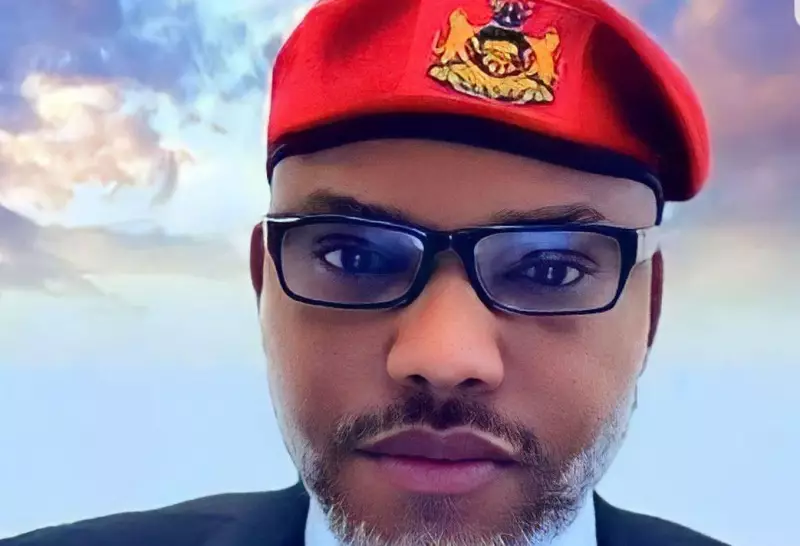
The Human Rights Writers Association of Nigeria (HURIWA) has strongly criticized the recent Federal High Court decision concerning Nnamdi Kanu, describing it as a major miscarriage of justice that violates fundamental constitutional protections.
Court Ruling Faces Constitutional Challenge
In a strongly worded statement released on November 21, 2025, HURIWA's National Coordinator, Comrade Emmanuel Onwubiko, condemned the ruling by Justice James Omotosho of the Federal High Court in Abuja. The rights organization characterized the judgment as a travesty of justice that fundamentally undermines the constitutional guarantee of fair hearing.
The association highlighted that the court failed to address critical legal questions raised by Kanu's legal team, particularly regarding his prosecution under the repealed Terrorism Prevention Act of 2013. HURIWA emphasized that the charge sheet does not reference any existing written law as required by Section 36(12) of the Nigerian Constitution, which they argue invalidates the entire legal proceeding.
Legal Foundation Crumbles Under Scrutiny
According to HURIWA's analysis, the court demonstrated inappropriate haste in delivering judgment while appeals concerning jurisdictional and procedural matters remained unresolved at the Court of Appeal. The rights group questioned Justice Omotosho's determination to expedite the case despite pending legal challenges to the validity of the charges.
Nothing in Nigerian jurisprudence permits a criminal trial to proceed when based on an inoperative statute, HURIWA asserted, underscoring their position that courts must resolve constitutional questions before advancing with trials. The organization referenced established case law requiring that jurisdictional objections be settled before trial proceedings continue.
Fair Hearing Rights Allegedly Violated
HURIWA accused the court of violating Section 36 of the Constitution, which guarantees every defendant the right to a fair hearing. The organization characterized the judge's conclusion that Kanu deliberately refused to enter a defense as disingenuous and misleading.
The rights group explained that Kanu maintained he could not present his defense until the court ruled on the legality and competence of the charges against him - a position HURIWA argues aligns perfectly with Nigerian criminal procedure principles. In extraordinary circumstances like this case, judicial restraint is required rather than speed, the association stated, noting unresolved appeals concerning issues of extraordinary rendition and charge legality.
HURIWA concluded that the judgment suffers from fundamental flaws due to the court's neglect of the repealed-law issue, its denial of Kanu's opportunity to present a proper defense, and its oversight of ongoing appeals. The association has called upon the National Judicial Council to review the case and urged the Court of Appeal to overturn what they describe as a ruling that offends both the law and the nation's conscience.