
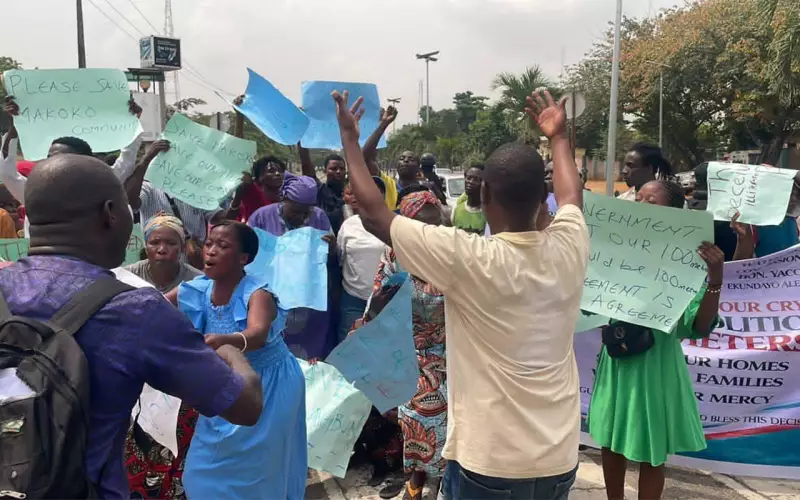
Residents of the historic Makoko waterfront community staged a major protest at the Lagos State House of Assembly on Thursday, January 15, 2026. The demonstrators, coming from the Ilaje Aiyetoro Community in the Yaba Local Council Development Area (LCDA), blocked part of the road to voice their strong opposition to the ongoing demolition of their homes by the state government.
Residents Plead for a 100-Metre Limit
The protesters, comprised of those directly affected by the demolition exercise, made a passionate appeal to the authorities. They urged the Lagos State Government to restrict the clearance to a 100-metre limit from the high-tension power lines. They warned that a more extensive operation would result in a severe humanitarian crisis, rendering thousands of families homeless and destroying generations-old livelihoods.
Despite the visible protest at the Assembly complex, government bulldozers and officials continued to pull down structures in Makoko. This simultaneous action suggested the state's operation was broader than initially communicated, targeting a larger swath of the community and not just buildings directly under the power cables.
Government Stance: A Matter of Safety and Law
In response to the outcry, the Lagos State Commissioner for Information and Strategy, Gbenga Omotoso, defended the government's actions. Speaking with The Guardian, Omotoso acknowledged the residents' right to protest but firmly stated the government's position was rooted in law and public safety.
"The law stipulates that buildings must be 250 metres away from power lines, but they are built under the power lines, and no government will accept that," Omotoso said. He revealed that the government had engaged the community in dialogues for over five years. He claimed an initial agreement was reached for a 100-metre buffer, which was later negotiated down to 50 metres, and the government had acted on that.
When questioned about providing alternative housing or compensation for the displaced, the Commissioner's response was unequivocal. "The moment we begin to compensate for illegality, illegalities will thrive," he stated, emphasizing that the government cannot approve houses under high-tension wires and that affected persons must leave.
Civil Society Condemns Evictions, Highlights Vulnerability
The demolition has drawn sharp criticism from civil society organizations. The Justice Empowerment Initiative, alongside the Nigerian Slum/Informal Settlement Federation, condemned the evictions. They and the residents have consistently called for the government to provide alternative arrangements for the vulnerable population before carrying out such exercises.
Makoko, a community where many families have lived in stilt houses over the water for generations, faces repeated threats of forced eviction. The residents largely depend on fishing and small-scale trading. The ongoing demolitions, justified by the government under urban development and safety mandates, are seen by the community as a direct attack on their welfare and survival.
The standoff highlights the persistent tension in Lagos between ambitious urban development plans and the rights of inhabitants in informal settlements. With the government standing firm on its safety rationale and the community fearing destitution, a lasting resolution remains elusive.




