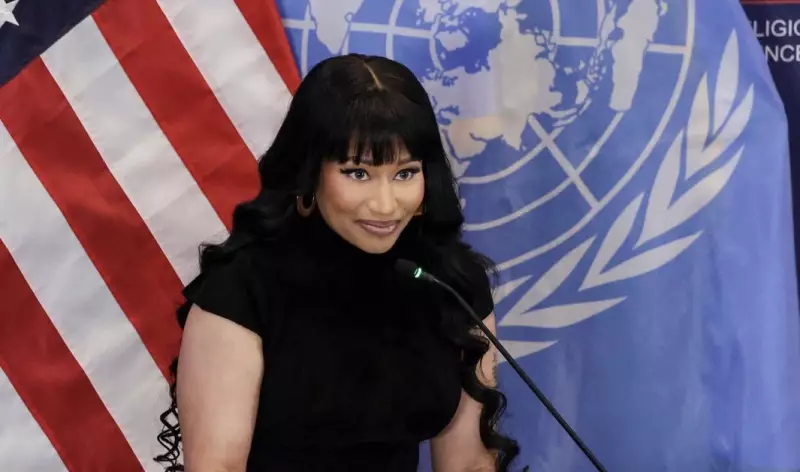
Former Nigerian lawmaker and civil rights activist Senator Shehu Sani has strongly condemned American rapper Nicki Minaj for making what he describes as false claims about Christian genocide occurring in Nigeria.
UN Platform Used for False Claims
Senator Sani, who served in the 8th National Assembly, expressed outrage that the United Nations provided a platform for the Trinidad and Tobago-born rapper to spread what he called "lies about fictitious genocide in Nigeria." The former lawmaker emphasized that Minaj lacks any genuine understanding of Nigeria's complex security situation.
"The rapper knew nothing about Nigeria and has never visited any community in conflict in Nigeria," Sani stated. "She has never taken up any humanitarian cause in Nigeria and has never helped anyone."
Questioning Minaj's Credibility and Motives
Sani contrasted Minaj with other Western celebrities who champion legitimate causes such as hunger relief, education, women's rights, children's welfare, landmine clearance, and gender health issues. He pointed out that Minaj has no track record of humanitarian work beyond what he described as "rapping gibberish and displaying outfits and physique incompatible with our African culture and tradition."
The former senator argued that Minaj's claims were not motivated by genuine concern but rather by "sycophantic and opportunistic meddling to gain Trump's endorsement." He suggested the rapper should focus her attention on her birthplace, Trinidad and Tobago, where he believes her voice could address real social issues.
"Minaj is just trying to appease and please President Trump, whose views and policies are directed against immigrants like Minaj," Sani asserted. "Minaj should not use Nigerian issues to please Trump."
Context of Nigeria's Security Challenges
This isn't the first time Sani has addressed such claims. He recently dismissed similar allegations made by US TV host Bill Maher about Christians facing genocide in Nigeria at the hands of Islamic terrorists.
Sani provided a nuanced explanation of Nigeria's security landscape, noting that bandits operate in the north-west, terrorists in the north-east, and a mixture of banditry, terrorism, ethno-religious violence, indigenous settlers conflicts, and farmers-herdsmen clashes in the north-central region.
"As far as bandits and terrorists are concerned, they do not discriminate their victims on the basis of their faith," Sani explained. "Muslims, just like Christians, are killed by bandits and terrorists. They attack churches and mosques. They kill pastors, priests, and imams."
He cited recent attacks in Katsina and Zamfara where Muslims were killed, as well as ongoing violence in Plateau and Benue states affecting both religious communities.
Political Dimensions of the Conflict
Sani highlighted an important political aspect of how violence is reported and addressed in Nigeria. Drawing from his senatorial experience, he noted that lawmakers from Christian-dominated southern Kaduna consistently raised alarms about attacks on their constituents, while Muslim lawmakers from northern Kaduna often remained silent.
"The senators and reps from the northern part of Kaduna who were Muslims were silent on the basis that the president at that time was a northerner, and that they shouldn't tell the world that Muslims were also killed," he revealed.
Senator Sani concluded that Minaj represents a poor role model for Nigerian and African girls and that her intervention in Nigerian affairs lacks both credibility and genuine humanitarian concern.