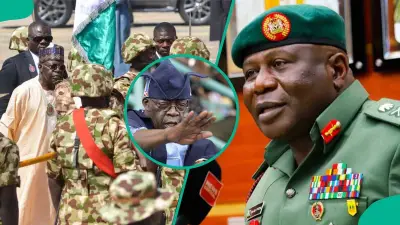
The ongoing controversy surrounding Federal Capital Territory Minister Nyesom Wike's confrontation with a naval officer has drawn significant political commentary, with Vice President Kashim Shettima's media aide now weighing in on the legal aspects of the dispute.
Legal Authority Under Land Use Act
Gimba Kakanda, media aide to Vice President Shettima, has come forward with a robust defense of Minister Wike's position in the recent land dispute that went viral. Kakanda emphasized that the Land Use Act grants the FCT Minister equivalent powers to state governors concerning land administration within Abuja's jurisdiction.
According to Kakanda's analysis published on Tuesday, November 11, 2025, the public outrage targeting Wike as a "land grabber" demonstrates misunderstanding of Nigerian land law. He stressed that the minister's control over land matters in the capital territory is legally established and protected by existing legislation.
Civilian Rule Versus Military Interference
Kakanda issued a strong warning about the implications of military personnel interfering in civilian administrative matters. He stated that any attempt by armed forces to obstruct the FCT Minister's authority undermines civilian governance and contradicts constitutional principles.
The vice president's aide challenged those supporting the naval officer's actions to identify where the Armed Forces Act permits a soldier to obey an "unlawful command" while remaining protected by the doctrine of superior orders. He maintained that Nigeria's constitution and the rule of law remain supreme over military instructions in civil matters.
Specific Legal Provisions Cited
Kakanda referenced specific sections of the Land Use Act to substantiate his position. He explained that Section 5 empowers both governors and the FCT Minister to allocate, manage, and revoke land for public purposes. This includes granting rights of occupancy, imposing penalties on defaulters, and reviewing or waiving conditions when necessary.
These provisions, he added, legally establish the FCT Minister as the trustee of all land within Abuja. Kakanda further pointed to Section 28, which allows revocation of land rights for overriding public interest, and Section 47, which protects the Minister's decisions from judicial interference unless a court issues a valid injunction.
"Without such an injunction, the Minister's administrative actions stand," Kakanda noted emphatically. He warned that no individual, including military personnel, has the right to occupy or develop land in Abuja without following due process established by law.
Wike's Earlier Statement on the Incident
The controversy stems from an incident where Minister Wike visited a disputed land site in Gaduwa, Abuja, after receiving reports that soldiers had driven away FCTA officials enforcing development control directives. In a statement released through his spokesperson Lere Olayinka, Wike condemned what he described as the illegal takeover of the disputed land by military personnel allegedly acting on orders of a former Chief of Naval Staff.
Wike characterized the soldiers' actions as unacceptable and lawless, asserting that no individual, regardless of their former position, would be permitted to intimidate government authorities or obstruct law enforcement.
Kakanda concluded that while Wike's personal appearance at the disputed site might have been unnecessary from a public relations perspective, his authority over land matters remains legally sound. He described the public reaction as primarily emotional and political rather than legally grounded.
"The rule of law must prevail over sentiment and military intrusion," Kakanda asserted, maintaining that unless a competent court rules otherwise, the powers of the FCT Minister remain fully intact under the Land Use Act.