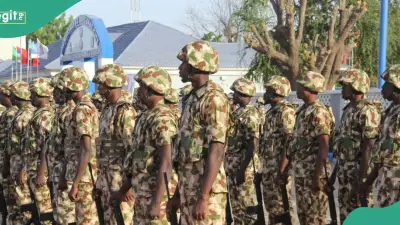
Former Secretary to the Government of the Federation, Babachir Lawal, has launched a devastating critique of President Bola Tinubu's handling of Nigeria's security crisis, accusing the administration of showing little commitment to protecting citizens and soldiers alike.
Government Not Interested in Fighting Insecurity
During an appearance on Channels Television's Politics Today program, Lawal delivered a blunt assessment of the current government's security approach. The former SGF contrasted Tinubu's methods with those of previous administrations, stating that both Goodluck Jonathan and Muhammadu Buhari demonstrated greater determination in confronting security challenges.
"Previous regimes were better; they were more accommodative," Lawal asserted. "They served Nigerians better in terms of equity, intention to fight corruption, and fairness and justice. Even in terms of insecurity, President Jonathan fought insecurity. President Buhari took over and fought insecurity; this present government is not interested in that."
Security Situation Worsening Under Current Administration
Lawal provided a concerning timeline of security deterioration, noting that before Tinubu assumed office in May 2023, relative peace had been achieved in some areas of the North-East zone, including his home state of Adamawa. However, he revealed that two years into this administration, the security situation has significantly worsened across multiple regions.
The former government official expressed particular alarm about the impact on military personnel, stating that he has personally witnessed the tragic consequences in his own community.
System Failure Costing Soldiers Their Lives
Lawal voiced deep frustration over what he described as institutional neglect of Nigeria's armed forces. Soldiers continue to die on the frontlines due to inadequate equipment and poor institutional support, creating what he characterized as a failed system that abandons those risking their lives for national security.
"I know soldiers are out there, some are losing their lives, quite a lot of them are from my community who have come back dead," Lawal disclosed. "Why are they losing their lives? Because the system that ought to support them has failed."
He provided a stark comparison of the equipment disparity facing Nigerian troops, explaining: "When you send a soldier into battle with an old, antiquated rifle that can only hold 20 rounds, and he's facing an enemy with one kilometre of bullets, you shoot once, it jams."
Questions About National Security Adviser's Performance
Lawal also directed criticism at National Security Adviser Nuhu Ribadu, questioning whether his office has produced any tangible results in addressing the country's security challenges. The former SGF stated he has yet to see evidence of effective work from the NSA's office despite the escalating security crisis.
"I don't see what work he is doing. If I see results of what they are doing, I will say it. It won't hurt me," Lawal remarked bluntly.
Defending the Buhari Administration's Record
In defending the administration where he served, Lawal claimed that the Buhari government made superior provisions for security forces. He suggested that having a former military leader in charge provided advantages in understanding and addressing security challenges.
"Our time was better, better arms were procured," Lawal stated. "We had the advantage that our own was a soldier. Our Head of State understood the issues and he did well. Maybe he [Tinubu] is not interested."
Tinubu's Instructions to Service Chiefs
The criticism comes despite President Tinubu's recent directive to newly appointed service chiefs to deliver decisive results in tackling insecurity. During the decoration ceremony for the new military chiefs at the State House, Abuja on Thursday, October 30, the president charged them to ensure the nation does not allow the security crisis that began in 2009 to continue.
Lawal's comments represent one of the most significant public criticisms from a former high-ranking official within the ruling party's circle, indicating growing concern about the government's approach to Nigeria's persistent security challenges.