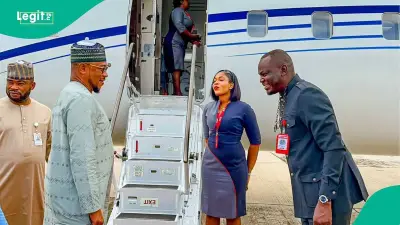
President Bola Ahmed Tinubu has declared that fragmented markets across Africa pose significant threats to border efficiency and continental trade, calling for disciplined action to transform border operations.
Africa's Border Challenge
Speaking at the opening of the Customs Pact – Partnership for African Cooperation in Trade on Monday, President Tinubu emphasized that while nations exist to complement each other, their size, resources, and talent become meaningless when trapped behind inefficient borders. The President, represented by Vice President Kashim Shettima, expressed Nigeria's firm commitment to building an Africa that trades by design, where integration becomes practical, measurable, and effective.
"Our ambition is simple: a continent where borders facilitate opportunities rather than inhibit them," President Tinubu stated. He warned that fragmented markets cannot achieve industrial scale, negotiate effectively with global powers, or withstand external economic shocks.
Practical Reforms Over Rhetoric
President Tinubu revealed that Nigeria is approaching this responsibility with practical systems and infrastructure rather than empty rhetoric. He stressed that the strength of a continental market must be engineered, not merely declared through official statements.
The President acknowledged that Africa has already taken the most difficult step by agreeing on integration through the African Continental Free Trade Area (AfCFTA). However, he emphasized that execution now becomes crucial, with success measured by tangible outcomes rather than communiqués.
"Success will be judged not by communiqués but by real outcomes, shorter border-crossing times, reliable local-currency settlements and efficient movement of goods across borders and ports," Tinubu declared.
Nigeria's Comprehensive Trade Reforms
The President outlined several key reforms implemented by his administration to enhance trade efficiency:
- Unification of the foreign exchange window
- Removal of fuel subsidies to redirect resources to critical infrastructure
- Modernization of port operations with 24-hour clearance systems
- Adoption of the Pan-African Payment and Settlement System (PAPSS)
- Prioritization of non-oil export growth across key sectors
These reforms have created a coherent foundation for stronger continental commerce and competitiveness, according to the President. He highlighted that Nigeria's institutions have been deliberately aligned into a unified trade-enablement architecture, breaking down traditional silos that once separated agencies.
Measurable Progress and Future Targets
President Tinubu provided concrete evidence of the reforms' impact on Nigeria's economy, describing it as "measurable, demonstrable and progressively accelerating." Key metrics include:
- Intra-African trade projected to expand from 15% in 2023 to 25% by 2030 under AfCFTA frameworks
- Nigeria's non-oil exports to African markets increased by 38% year-on-year in 2024
- Cargo clearance time at major seaports reduced by approximately 30% since 2023
- Paper-based compliance processes being systematically replaced through digital trade reforms
The President announced that phase one of the transformative National Single Window (NSW) digital platform will go live in March 2026, with full rollout expected by December 2026. This system will allow businesses to submit import and export information once through a unified portal and is expected to cut cargo clearance time from 21 days to under 7 days.
Other speakers at the event, including Minister of Finance Wale Edun and Minister of Industry, Trade and Investment Dr. Jumoke Oduwole, echoed the President's sentiments, emphasizing Nigeria's commitment to supporting modernization initiatives and ensuring AfCFTA delivers tangible benefits for citizens while improving the ease of doing business at borders.