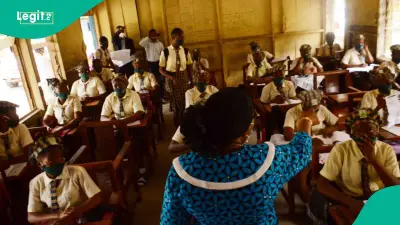
Prominent education stakeholders and human rights organizations have launched a strong appeal to the Federal Government to immediately reverse the suspension of the 2022 National Language Policy, describing the decision as premature and detrimental to Nigeria's educational development.
Academic Expert Challenges Minister's Rationale
Professor Aderemi Obilana, Chief Executive Officer of Prakis Educational Services and Visiting Professor at the University Institute of Applied and Human Sciences in the Republic of Chad, has strongly criticized Education Minister Dr. Tunji Alausa's decision to halt the language policy implementation. The academic, who also serves as an independent contractor at the University of South Africa, described the suspension as unfounded and harmful to Nigeria's cultural and educational progress.
In a statement released yesterday, Professor Obilana urged the Nigerian government to emulate successful educational models from countries like China, Singapore, South Africa, and Finland, where indigenous languages are effectively integrated into the education system. He argued that the minister's justification for cancellation—citing poor student performance in WAEC, NECO, and JAMB examinations—lacks empirical basis and contradicts global research on educational best practices.
Evidence Supporting Mother Tongue Education
Contrary to the minister's position, Professor Obilana presented substantial evidence demonstrating that children taught in their mother tongue during foundational schooling develop stronger reading comprehension skills and enhanced cognitive abilities. He referenced UNESCO's position during the 25th anniversary of International Mother Language Day, which reaffirmed that instruction in indigenous languages significantly improves learning outcomes and cognitive development.
"There is no empirical basis to conclude that indigenous language instruction negatively impacted the performance of candidates in national examinations," Obilana stated, emphasizing that the decision fails to reflect contemporary educational research and global best practices.
Human Rights Group Threatens Legal Action
The Human Rights Writers Association of Nigeria (HURIWA) has taken an even stronger stance, threatening to initiate legal proceedings against what it describes as "government-sponsored cultural, scientific and educational suicide." The organization argues that abolishing mother tongue instruction for Nigerian school children has set the country's cultural, educational, and scientific advancements back by 100 years compared to contemporary civilizations.
HURIWA's National Coordinator, Emmanuel Onwubiko, posed a critical question: "Does it even make sense to teach our children in a foreign language of English when most of the greatest scholars and thinkers, whose works we use in schools, initiated these intellectual works and inventions in their distinctive mother tongue?" He emphasized that not all scientists or mathematics experts originate from England, questioning why Nigerian children should be compelled to learn exclusively in the English language.
The organization has begun discussions with approximately 200 lawyers nationwide and leaders of cultural organizations to prevent what they consider a regressive educational policy. HURIWA is also urging State Houses of Assembly to legislate the use of mother tongue policy in early childhood education within their respective jurisdictions.
This developing controversy highlights the ongoing tension between global educational standards and cultural preservation in Nigeria's educational system, with stakeholders demanding immediate government action to protect the nation's linguistic heritage and improve learning outcomes through mother tongue instruction.