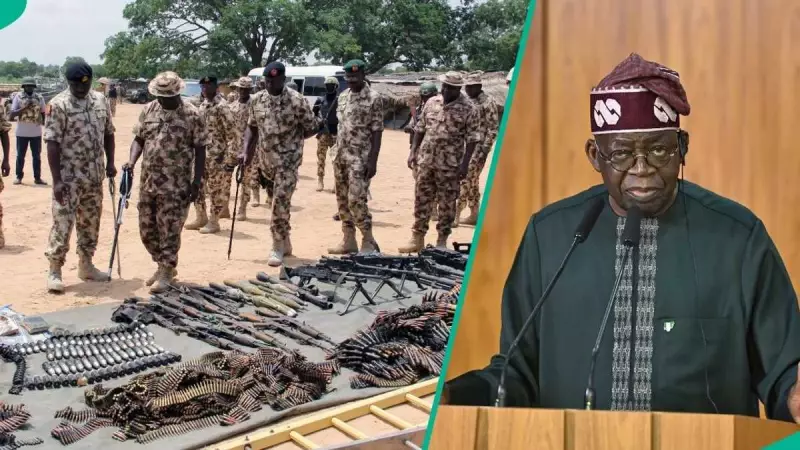
Recent data from the National Bureau of Statistics has revealed that Nigeria allocated a staggering N776.9 billion to arms and ammunition imports between 2020 and the first quarter of 2025, highlighting the massive financial commitment to addressing the country's security challenges.
Year-by-Year Breakdown of Military Spending
The foreign trade report for Q2 2025 shows a dramatic escalation in defence spending over the five-year period. According to the statistics, Nigeria began with N29.24 billion in arms imports during 2020, which then surged to N72.50 billion in 2021.
Interestingly, there was a temporary dip in 2022 when spending decreased to N28.24 billion, but this was followed by a substantial jump to N127.16 billion in 2023. The most significant expenditure occurred in 2024, when arms imports skyrocketed to N520.02 billion, marking the highest annual military import bill in recent Nigerian history.
Data for the first half of 2025 indicates that Nigeria has already spent N26.95 billion on imported weapons, suggesting the trend of substantial defence spending continues.
Massive Security Budget Allocation for 2025
The revelations about arms imports come alongside the disclosure of Nigeria's comprehensive N6.57 trillion Security and Defence Budget for 2025. According to BudgIT's analysis, this enormous allocation is distributed across various security sectors and purposes.
The breakdown shows that N4.07 trillion is designated for personnel costs, while N1.50 trillion is allocated for capital expenditure and N642.55 billion for overhead expenses. The specific agency allocations include the Defence sector receiving N3.10 trillion, Ministry of Police Affairs getting N1.31 trillion, and Interior ministries (covering Immigration, Civil Defence, etc.) allocated N1.11 trillion.
Additional allocations include the Office of the National Security Adviser receiving N690.84 billion, Service-wide Votes getting N638.34 billion, and the Police Service Commission allocated N2.56 billion.
Security Challenges Driving Defence Expenditure
The substantial increase in military spending directly correlates with Nigeria's escalating security crisis. The country faces multiple security threats including terrorism from groups like Boko Haram and ISWAP, widespread banditry and kidnapping particularly in the Northwest region, and separatist agitations such as IPOB in the Southeast.
These complex security challenges have placed unprecedented pressure on Nigeria's military and security agencies, necessitating increased spending on personnel, equipment, and ongoing operations. The consistent year-on-year increase in arms imports reflects the government's response to these mounting security concerns.
Despite the massive financial investment in security, retired General Ishola Williams, former chief of Defence Training and Planning, has expressed confidence that Nigeria could overcome its insecurity challenges within six months without continuous weapons purchases. He emphasized the need to reorganize security agencies and properly maintain existing military equipment in the arsenal.
The revelation of these substantial defence expenditures raises important questions about resource allocation and effectiveness in addressing Nigeria's security crisis, particularly as citizens continue to face threats across various regions of the country.