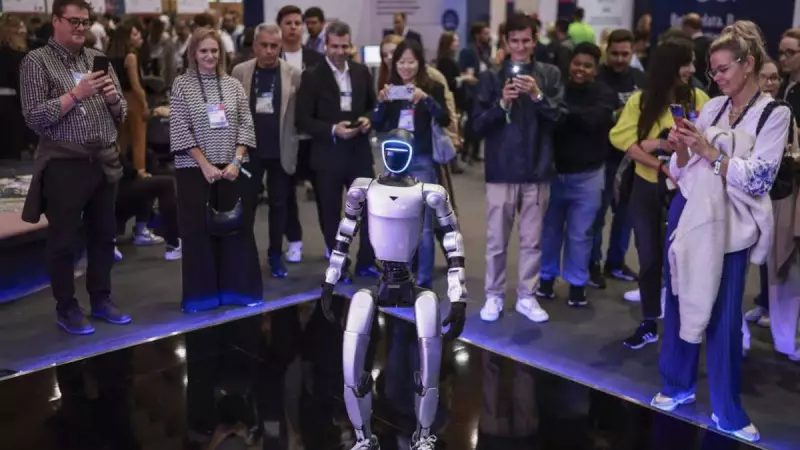
While agile humanoid robots captivated audiences at this week's Web Summit in Lisbon, a leading voice from Amazon's robotics division has poured cold water on the idea that they will soon transform physical work in factories and warehouses.
Function Over Form: The Amazon Robotics Philosophy
Tye Brady, Amazon's chief roboticist, expressed skepticism in a Wednesday interview, suggesting that the development of flashy humanoids can sometimes be an exercise in 'technology for technology's sake.' He outlined Amazon's fundamentally different approach to robotics.
'Whenever we think about robotics, we think about, A, what's the problem we're trying to solve? And, B, then function,' Brady explained. 'From function, we derive form. And it kind of gets it backwards if you start with form.'

This perspective stands in stark contrast to the excitement generated by Chinese manufacturer Unitree, whose breakdancing androids were highlighted by Web Summit organiser Paddy Cosgrave as evidence that 'the era of Western tech dominance is fading.'
Amazon's Real-World Robotics Fleet
Brady instead pointed to Amazon's own massive and practical deployment of robotics. The e-commerce giant already uses more than one million robots in its operations. These are not humanoids but specialized machines designed for specific tasks.
Amazon's current robotic workforce includes:
- Robotic arms for picking and sorting items.
- Wheeled haulers that transport heavy loads.
- Machines equipped with sensors to safely navigate around human employees.
This fleet is a significant part of the global landscape. According to a September report from the International Federation of Robotics, there were around two million industrial robots in service across China in 2024 and more than 4.5 million worldwide.
The Path Forward for Robotics and AI
Brady acknowledged that the world is still in the 'early stages of robotics, of physical AI.' However, he was clear that for Amazon, the goal is not full automation. 'There is no such thing as 100 percent automation,' he stated, emphasizing that their machines are designed to augment human workers by eliminating mundane and repetitive tasks.
He conceded that certain aspects of the humanoid form, like bipedal locomotion for navigating stairs or uneven terrain, could be useful. Yet, the real challenge lies in what the robot can do upon arrival. 'I can move to wherever... but once you get there, there's probably a task that you need to do. And that task is going to now involve some sort of sense of touch, some sort of manipulation,' Brady noted.
This gap between mobility and practical function has led some companies to overpromise. Brady's comments come after California startup 1X offered a $20,000 home help android for pre-order, a move met with both excitement and derision, especially since its 'expert mode' relied on remote human operation for complex tasks.
Looking ahead, Brady envisions a future where the focus remains on capability. 'If you start to combine... aptitude in mobility and manipulation, and free yourself from form and focus more on the function, that's actually going to be really great,' he concluded, signalling that for the world's leading e-commerce company, practical problem-solving will continue to trump futuristic spectacle in the realm of robotics.