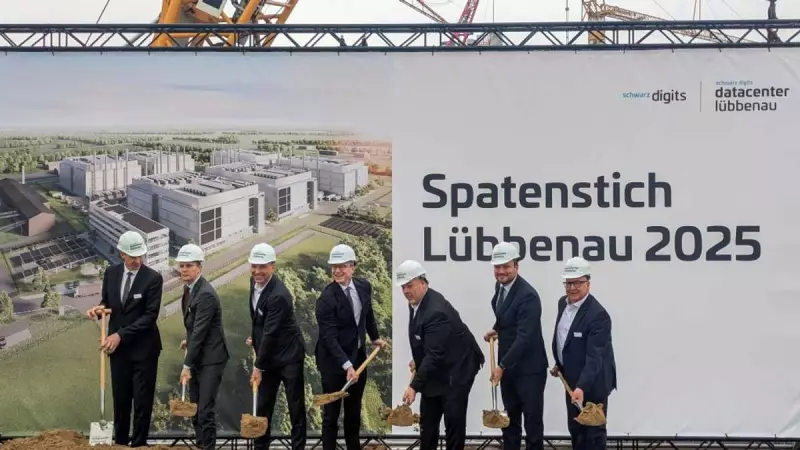
In a significant move to strengthen Europe's position in the global artificial intelligence race, Germany has officially begun construction of a massive €11 billion data centre in the eastern town of Luebbenau.
Boosting European Digital Independence
The groundbreaking ceremony took place on Monday, with German Minister for Digitalisation and Government Modernisation Karsten Wildberger joining executives from the Schwarz Group, owners of popular discount retailers Lidl and Kaufland. Despite light rainfall, the event marked the start of what officials describe as a crucial project for Europe's digital future.
Minister Wildberger declared the facility would become "the backbone of Germany's digital sovereignty", emphasizing that companies would finally be able to work with their own data and that of European customers without relying on US-based storage with weaker privacy protections.

Massive Scale and Ambitious Timeline
The data centre complex will be built on the site of a former power plant in the Spreewald region, which was operational during East Germany's communist era. The project consists of six enormous modules, each equivalent to four football fields in size.
According to Rolf Schumann, co-director of Schwarz Digits, the subsidiary managing the project, the facility will eventually accommodate up to 100,000 GPUs - the critical computer processors essential for training advanced AI systems. This massive capacity qualifies the site as what industry experts call an AI "giga-factory".
Three of the six planned data centres are expected to become operational by the end of 2027, though current progress shows only preliminary construction with concrete columns and cranes visible at the vast site.
Addressing Europe's AI Deficit
The project comes as Europe acknowledges its significant lag behind the United States and China in key AI infrastructure areas, including microchip manufacturing and cloud computing capabilities. Barbara Engels, a researcher at the Cologne Institute for Economic Research, provided sobering context, noting that the United States already possessed ten times more computing capacity in 2024 than Germany is projected to have by 2030.
Schumann emphasized that the Luebbenau data centre would provide "secure and independent infrastructure" enabling European businesses and citizens to "shape their digital future autonomously". Among the anticipated clients is Stackit, the Schwarz Group's cloud computing firm aiming to compete with American giants like Amazon Web Services and Microsoft Azure.
The timing aligns with broader European efforts to reclaim control of digital policy, evidenced by Germany hosting a tech "sovereignty" summit in Berlin this week, jointly led by Chancellor Friedrich Merz and French President Emmanuel Macron.
Environmental Considerations and Community Benefits
Project designers have addressed environmental concerns by committing to power the facility with green energy and utilizing recycled concrete and steel from the former power plant. However, researchers like Engels caution that such AI data centres have "a huge ecological footprint" and question whether Germany can generate sufficient renewable energy to support this intensive digital infrastructure.
The Schwarz Group has proposed an innovative solution to mitigate environmental impact: using residual heat from the computer servers to warm thousands of nearby homes starting from 2028, potentially turning an environmental challenge into a community benefit.
This €11 billion investment represents Europe's determined effort to close the technology gap with global AI leaders while maintaining control over its digital destiny and adhering to European data protection standards.