The Dawn of Physical Artificial Intelligence
The world stands at the brink of a technological revolution as artificial intelligence begins to step out of computer screens and into our physical reality. Tech companies worldwide are pouring massive investments into what industry leaders call physical AI - intelligent systems that can understand and interact with the material world around them.
Global Race for Humanoid Robotics
According to financial giant Morgan Stanley, the world could witness an astonishing more than one billion humanoid robots by the year 2050. This prediction comes as companies across the globe accelerate their development of advanced robotic systems capable of performing human-like tasks.
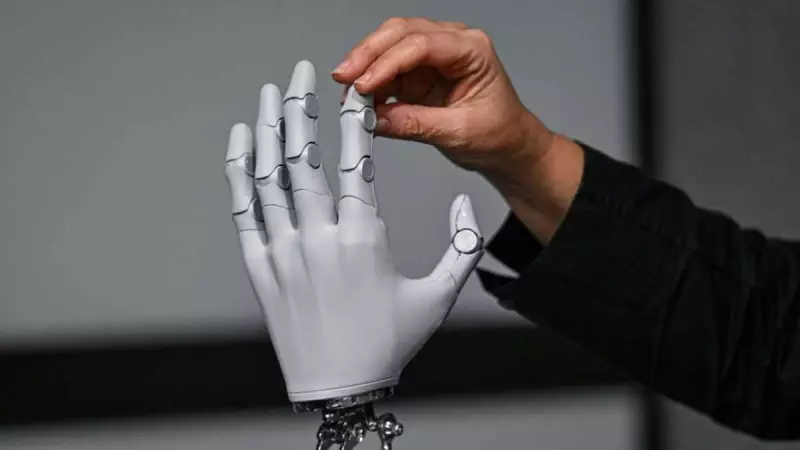
In Tokyo, company Enactic demonstrates the practical applications of this technology. Their human-like robotic arms, controlled by operators using VR headsets, are being trained to handle everyday chores like washing dishes and doing laundry. The company's 24-year-old CEO Hiro Yamamoto plans to deploy these robots in Japanese care homes facing staff shortages as early as next summer.

"The next wave of AI is physical AI," declared Jensen Huang, head of US chip giant Nvidia, last year. "AI that understands the laws of physics, AI that can work among us and understands how to perceive the world."
International Competition and Current Limitations
The global competition in physical AI has intensified significantly, with Chinese companies emerging as strong contenders. Chinese electric vehicle maker XPeng recently unveiled its latest humanoid robot that walked slowly across a stage to cheers from the audience in Guangzhou.
XPeng CEO He Xiaopeng made a bold prediction, stating that in ten years, robot sales could surpass car sales. The company's co-president Brian Gu went even further, suggesting that with enough data and training, AI humanoid robots could eventually perform "almost any human role" from nanny to home chef or gardener.
However, significant challenges remain. Current demonstrations often highlight robots dancing to Taylor Swift or pulling heavy objects, but the more complicated task of handling objects with dexterity has not been widely shown. The cost also presents a barrier - one robot hand that requires regular replacement for heavy-duty work could pay a Chinese worker's salary for years.
Practical limitations were embarrassingly evident when a Russian humanoid robot, said to be the country's first, staggered and fell flat on its face during its stage debut earlier this week.
Training the Robots of Tomorrow
The approach to developing physical AI differs significantly from text-based AI like ChatGPT. While language models learn from vast amounts of text, physical AI must understand vision and spatial relationships between objects.
Currently, the most reliable method involves remote operation where human operators control robots to teach them specific tasks. According to Enactic's Yamamoto, just 30 to 50 demonstrations of each task are needed to fine-tune what experts call "vision-language-action" AI models.
Companies are taking practical approaches to training their systems. Enactive has approached dozens of Japanese care facilities to deploy teleoperated robots for menial tasks, providing valuable real-world experience that will eventually enable autonomous operation.
Similarly, US-Norwegian startup 1X plans to deliver its $20,000 humanoid home helper called NEO to American homes starting next year, though current demonstrations show the technology still has room for improvement with robots sometimes struggling with basic tasks like closing a dishwasher door.
Economic Impact and Future Concerns
The rapid advancement in physical AI has sparked both excitement and concern. While the promise of robot butlers captures public imagination, serious questions emerge about job losses, privacy implications, and the realistic timeline for these technologies to become truly useful.
Investment in the sector continues to grow, with Japan's SoftBank recently announcing physical AI as its "next frontier" as it acquires industrial robot maker ABB Robotics for $5.4 billion.

Despite concerns about automation replacing human workers, experts like Sara Adela Abad Guaman, assistant professor in robotics at University College London, remain cautiously optimistic. She notes that "our sense of touch is incomparable" to current robotic capabilities, and nature shows that adapting to environments requires the right physical form - something current robotics still struggles to achieve.
As the physical AI revolution gathers momentum, the world watches closely to see how these technologies will transform industries, workplaces, and daily life in the coming decades.