
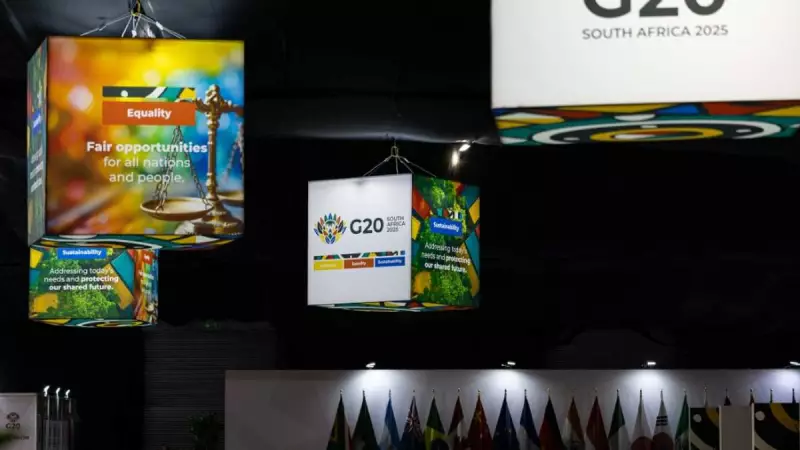
South Africa is preparing to host the G20 summit this weekend, with ambitious plans to secure crucial commitments on debt relief for developing nations and address pressing global inequalities. The event takes place under the shadow of a significant boycott by the United States, marking another chapter in Washington's retreat from multilateral engagements.
US Absence and Global Implications
US President Donald Trump will not attend the November 22-23 summit in Johannesburg, continuing his pattern of disengaging from international forums. The decision follows clashes between the Trump administration and South Africa over the summit's agenda, which US Secretary of State Marco Rubio previously labeled as "anti-American" back in February.
President Cyril Ramaphosa responded to the US absence with characteristic diplomacy, telling reporters that the boycott represents "their loss." The United States remains the most influential member of the G20, which collectively represents 85 percent of global GDP and approximately two-thirds of the world's population.
The current US boycott mirrors similar actions taken by the Trump administration, including the decision to skip the COP30 climate summit in Brazil and the earlier withdrawal from the Paris Agreement. Additionally, the United States has imposed unilateral tariffs of 30 percent on South Africa, further straining relations between the two nations.
South Africa's Ambitious Agenda
Operating under the theme "Solidarity, Equality, Sustainability," the South African presidency has prioritized several critical issues affecting developing economies. The central focus includes securing meaningful debt relief and establishing financing mechanisms to help nations cope with climate-induced disasters.
South African officials emphasize that debt repayments severely limit investments in essential sectors such as infrastructure, healthcare, and education. According to United Nations data covering 2021 to 2023, African nations spent $70 per capita on debt interest payments compared to $63 on education and only $44 on healthcare.
President Ramaphosa will also advocate for establishing an "International Inequalities Panel" modeled after the Intergovernmental Panel on Climate Change (IPCC). This proposed body would address the growing wealth gap that threatens global social cohesion and democratic stability.
Global Participation and Challenges
The summit faces uncertainty regarding achieving consensus and producing a joint declaration, particularly given the absence of key players. Argentina's representatives have reportedly been obstructive during preparatory discussions, and President Javier Milei—a Trump ally—has joined the boycott.
In contrast, China's Premier Li Qiang is expected to champion multilateralism during the discussions. Speaking at a regional Asian summit in October, Li emphasized that "economic globalisation and multipolarity are irreversible."
Russia will be represented by President Vladimir Putin's economic advisor and deputy chief of staff, Maxim Oreshkin, rather than Foreign Minister Sergei Lavrov. The event concludes a cycle of G20 presidencies held by Global South nations, following Indonesia (2022), India (2023), and Brazil (2024).
Looking ahead, the United States will assume the G20 presidency next and has already indicated plans to narrow the forum's focus to economic cooperation matters. The December 2026 meeting is scheduled to take place at a Miami golf course owned by the Trump family.
The Johannesburg summit represents a critical moment for developing nations to advance their priorities on the global stage, even as major power dynamics continue to shift and challenge traditional multilateral frameworks.




