
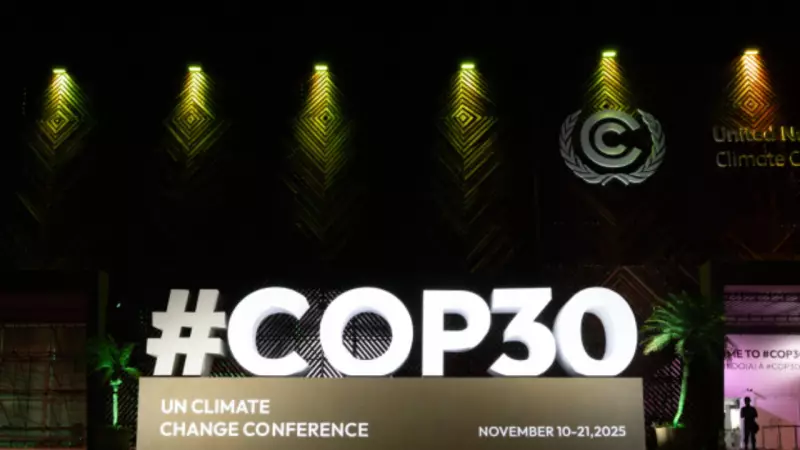
The COP30 climate summit has officially concluded after two intensive weeks of negotiations in the Amazonian city of Belem, Brazil. The event, attended by nearly 200 nations, witnessed dramatic moments including protests, street marches, and even a fire, but ultimately produced significant decisions in the global fight against climate change.
Fossil Fuels and the "Mutirao" Pact
The most contentious issues were consolidated into what became known as the "mutirao" pact, drawing from the Tupi-Guarani word meaning "collective effort." This agreement established a framework for countries to voluntarily collaborate on reducing carbon emissions and working toward the critical goal of limiting global warming to 1.5 degrees Celsius above pre-industrial levels.
While the final text acknowledged the commitment made at COP28 in Dubai to "transition away from fossil fuels," it notably omitted this exact phrase, which has grown politically sensitive. Despite strong pressure from over 80 nations spanning Europe, Latin America, and the Pacific, the conference did not adopt a formal roadmap to phase out fossil fuels.
Instead, COP30 president Andre Correa do Lago proposed creating separate voluntary plans: one for countries willing to join a fossil fuel phase-out initiative and another focused on halting deforestation.
Financial Breakthrough for Developing Nations
In a significant victory for developing countries, the final agreement "calls for efforts to at least triple adaptation finance by 2035." This addresses long-standing complaints from the world's poorest nations about insufficient funding for protective measures against climate impacts, such as building sea walls and other adaptation infrastructure.
The context for this commitment stems from 2024, when wealthy nations agreed to provide $300 billion annually by 2035 in climate finance to developing countries. However, that agreement lacked specific earmarking for adaptation projects, with most funds traditionally directed toward emission-reduction initiatives like renewable energy.
The new tripling goal could potentially direct approximately $120 billion of the $300 billion specifically toward adaptation, though observers noted that clarity around this target remains necessary.
Trade, Forests, and Methane Commitments
For the first time in climate negotiations, trade was formally included as a pillar of the final text. The agreement establishes a three-year dialogue on trade within the climate framework, reflecting concerns from countries including China about potential trade measures like carbon taxes that could impact export revenues or create barriers to green technology sales.
On forest conservation, Brazil launched the innovative Tropical Forests Forever Facility (TFFF), a global investment vehicle designed to compensate forest-rich countries for each hectare of trees they preserve. Brazilian President Luiz Inacio Lula da Silva announced the initiative even before COP30 officially began.
The TFFF has already attracted $5.5 billion in pledges from major contributors including Norway, Germany, Indonesia, France, and Brazil itself. Ultimately, Brazil aims to raise $125 billion in combined public and private investment, with the fund able to commence operations even without the full $25 billion in startup capital from governments.
Regarding methane emissions, considered the second-largest contributor to climate change after carbon dioxide, seven nations made significant commitments. Britain, France, Canada, Germany, Norway, Japan, and Kazakhstan signed a statement vowing to achieve "near zero" methane emissions across the fossil fuel sector. This is particularly crucial given methane's potency—approximately 80 times more powerful than CO2 over a 20-year period, despite its shorter atmospheric lifespan of about 12 years.
The COP30 summit, while not delivering everything climate advocates had hoped for, represents another step forward in the complex, multilateral effort to address the global climate crisis through both negotiated agreements and voluntary commitments from participating nations.




