
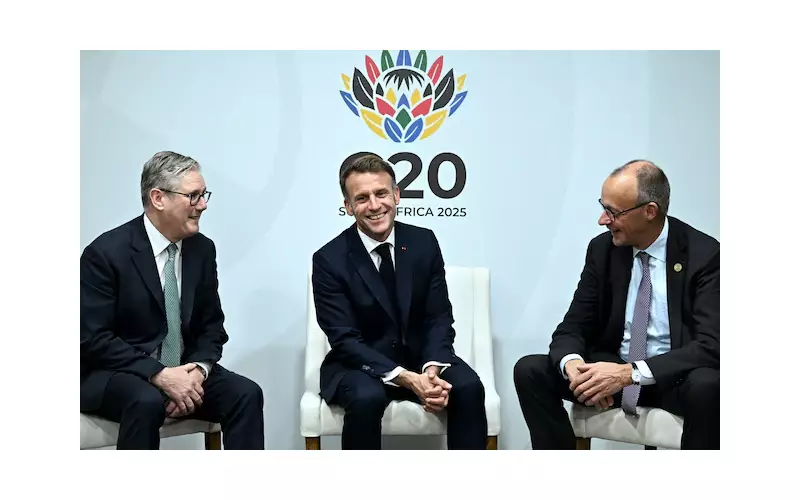
Europe Challenges US Peace Plan with Revised Ukraine Proposal
European nations have unveiled a comprehensive 28-point counter-proposal for ending the war in Ukraine, directly responding to a peace plan previously presented by US leader Donald Trump. The European initiative emerged on Sunday, November 23, after the original American proposal caused significant concern among Kyiv's international allies.
The Trump administration's initial peace framework had reportedly leaned toward Russia's hardline positions while offering limited security guarantees for Ukraine. What particularly alarmed European partners was that the US developed its proposal without consulting the E3 nations - Britain, France, and Germany.
Key Differences in European Counter-Offer
The European counter-proposal uses the American plan as its foundation but introduces crucial amendments, especially concerning NATO's role in Ukraine's future. This represents a significant departure from the original Trump proposal, which had demanded that Ukraine constitutionally bind itself not to join NATO and prohibited any NATO peacekeepers on Ukrainian territory.
The European text explicitly states that Ukraine joining NATO would depend on consensus among member states, while acknowledging that such consensus does not currently exist. Regarding military presence, the E3 proposal agrees that NATO would not permanently station troops in Ukraine during peacetime, but appears to leave room for a "coalition of the willing" to have greater involvement.
European leaders maintained the original provision concerning Ukraine's eligibility for EU membership without changes. However, they significantly strengthened language about Ukraine's post-war reconstruction, insisting the country must be "fully" rebuilt and financially compensated, explicitly including funds drawn from seized Russian sovereign assets.
Detailed Breakdown of the 28-Point Plan
The European-backed peace agreement contains several critical provisions that differentiate it from the American proposal. Point 3 of the original US plan has been completely deleted, which had stated: "There will be the expectation that Russia will not invade its neighbours and NATO will not expand further."
Key military provisions include capping Ukraine's peacetime military at 800,000 troops and stationing NATO fighter jets in Poland. The security guarantee from the United States mirrors Article 5 protections but includes specific conditions: the US would receive compensation for the guarantee, Ukraine would forfeit protection if it invades Russia, and all global sanctions would be restored if Russia invades Ukraine.
On territorial matters, Ukraine commits not to recover occupied sovereign territory through military means. Negotiations on territorial swaps would start from the current Line of Contact. Once future territorial arrangements are agreed, both Russia and Ukraine undertake not to change these arrangements by force.
The proposal includes extensive economic components, featuring a robust global redevelopment package for Ukraine that includes technology investments, gas infrastructure modernization, and special World Bank financing. Meanwhile, Russia would be progressively reintegrated into the global economy with phased sanction relief and potential invitation back into the G8.
Implementation and Monitoring Mechanisms
The European plan establishes concrete implementation frameworks, including a joint Security taskforce with participation from the US, Ukraine, Russia, and European nations to promote and enforce all agreement provisions. A Board of Peace would monitor implementation, chaired by President Donald J. Trump, with penalties for violations.
Humanitarian measures include establishing a committee to resolve open issues, including prisoner exchanges on an "All for All" basis, returning civilian detainees and children, family reunification programs, and addressing victim suffering.
The agreement would become legally binding upon adoption, with a ceasefire immediately effective once all sides agree to the memorandum and withdraw to agreed-upon positions. Both parties would agree on ceasefire modalities under US supervision.
It remains understood that any final agreement, even if backed by both the United States and European nations, would still require approval from Russia to take effect, making the path to peace complex and uncertain.




