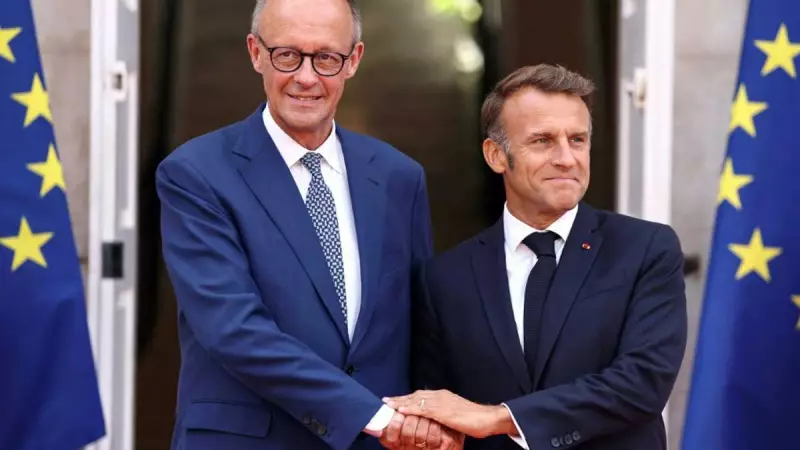
German Chancellor Friedrich Merz and French President Emmanuel Macron are set to launch a major push for European digital sovereignty during a high-profile summit in Berlin on Tuesday. The leaders of Europe's two largest economies will advocate for reduced dependence on American technology titans as the global artificial intelligence race intensifies.
Europe's Digital Independence Drive
The Berlin digital summit brings together key political figures and industry leaders, including CEOs from prominent European technology firms such as French AI company Mistral and German software giant SAP. With artificial intelligence becoming increasingly critical across multiple sectors, European leaders are responding to mounting pressure for the continent to take control of its digital future.
German Digital Minister Karsten Wildberger emphasized that the summit's central message will be Europe's readiness to shape its own digital destiny and decrease foreign dependencies. "We can make better progress by working together," Wildberger stated during a groundbreaking ceremony for an 11-billion-euro data center outside Berlin.

Regulatory Changes and Cloud Computing Ambitions
The European Union faces criticism for moving too slowly in the AI competition against the United States and China. Later this week, the EU is expected to propose relaxing rules on artificial intelligence and data protection, a topic that will feature prominently at the Berlin discussions.
Both European businesses striving to catch up and American tech giants have complained about current regulations, though the EU now faces accusations of prioritizing competitiveness over citizen privacy.
Cloud computing sovereignty represents another crucial agenda item. Proponents argue that developing EU-controlled cloud facilities would better protect European data in a sector currently dominated by US companies like Google, AWS, and Microsoft. German software powerhouse SAP plays a key role in industrial cloud computing and will contribute significantly to these discussions.
Addressing Long-standing Dependencies
Beyond concerns about American technology dominance, Europe faces more established worries about reliance on companies from Communist Party-ruled China and other Asian nations for hardware components, ranging from semiconductors to laptop parts.
A recent survey by digital business association Bitkom revealed that approximately 90 percent of German companies importing digital goods or services consider themselves dependent on these foreign suppliers.
Bitkom President Ralf Wintergerst stressed the urgent need for increased digital sector investment in Europe. "Europe must not fall behind—today's investments secure tomorrow's competitiveness and jobs," he told AFP. "If Europe does not want to become a museum of technology, we must ramp up investment significantly."
Europe confronts substantial challenges in this endeavor. The region struggles with prolonged economic weakness, and its technology firms remain considerably smaller than their American competitors. Recent data shows Europe's data centers—essential for AI development—have computing capacity of just 16 gigawatts, compared to 48 in the United States and 38 in China.
Recent investment announcements in Germany, including billions from Google and a partnership between US chip leader Nvidia and Deutsche Telekom for an industrial AI hub, have highlighted the continued dependence on American technology, according to critics.
Despite transatlantic tensions, a senior French presidential official clarified that the summit focuses not on "confrontation" with the United States or China, but rather on "how we protect our core sovereignty and what rules need to be established, especially at the European level."
Merz and Macron will deliver keynote addresses during the afternoon session, joined by digital ministers from across Europe. Following the summit, both leaders will dine with British Prime Keir Starmer, though German government spokespeople haven't disclosed what the trio will discuss.