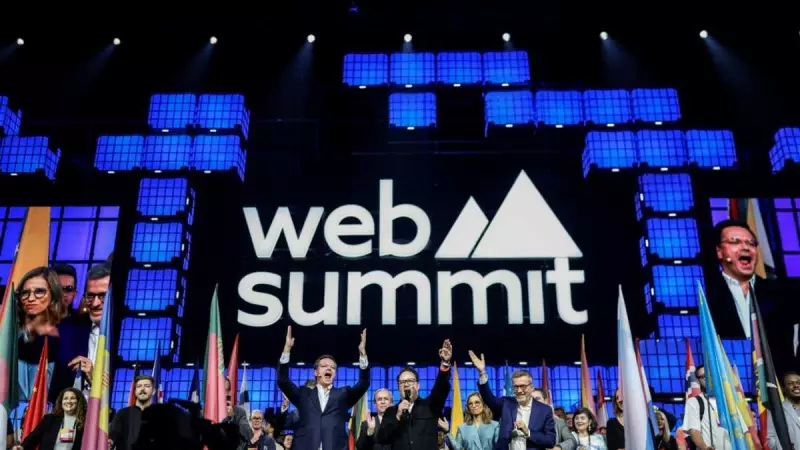
Global technology leaders are converging on Lisbon this week for the annual Web Summit, a key event often dubbed the 'Davos for geeks.' The gathering, running from Tuesday, will dive deep into critical topics like Artificial Intelligence, robotics, and the startup ecosystem, all set against a backdrop of rising global tensions over advanced technology and the essential natural resources required to power it.
A New Multipolar Tech World Emerges
Organisers report that the four-day summit is set to host a massive crowd of over 70,000 visitors, featuring 2,500 startups and 1,000 investors. The opening night on Monday set a vibrant tone, showcasing Swedish startup founder Anton Osika, whose company Lovable is being hailed as the fastest-growing software firm in history. The audience was also treated to appearances by TikTok sensation Khaby Lame, tennis legend Maria Sharapova, and an Olympics-style parade of tech founders carrying their national flags.
The most striking declaration came from Web Summit founder Paddy Cosgrave. "This year, more than any year before, it's clear that the era of Western tech dominance is fading," he stated. Cosgrave pointed to Chinese manufacturers leading in fields like AI and humanoid robots, the success of Brazil's digital payments system PIX, and a record number of Polish startups as clear evidence of a more fragmented and multipolar technology landscape.

Robots, AI, and the Chip Wars
Beyond the celebratory atmosphere, the event is shadowed by serious discussions on hi-tech trade, competition, and sovereignty. A key exhibit features what are described as the "most advanced humanoid robots in the world," which, as Cosgrave noted, are not from Europe or America but from China. Despite this, US influence remains strong with speakers like Amazon Robotics chief Tye Brady and Robert Playter of Boston Dynamics.
The race for autonomous vehicles is also heating up. Uber president Andrew Macdonald and Lyft's CEO David Risher are promoting plans to fill city streets with robotaxis. Uber has partnered with Nvidia to upgrade tens of thousands of its vehicles with automation technology starting in 2027. Meanwhile, Waymo, a subsidiary of Google's parent Alphabet, plans to launch its driverless cars in London next year, with Chinese firms like Baidu and Pony.ai also targeting the European market.
The struggle for supremacy is perhaps most intense in the field of generative artificial intelligence. American chip developer Qualcomm, led by boss Cristiano Amon, has announced new AI chips designed to compete with sector giants Nvidia and challenger AMD. These high-end processors are subject to US export restrictions due to national security concerns. Microsoft president Brad Smith is also among the top AI leaders present.
Tech Sovereignty and The Future
The trend of 'vibe coding' is another highlight, with startups like Lovable enabling users to create apps and websites through a chatbot without any coding knowledge. "We're seeing 100,000 new products built on Lovable every single day," revealed founder Anton Osika. This approach was so significant that the British dictionary publisher Collins named it the word of the year for 2025.
European concerns over technological sovereignty are a major undercurrent. The European Commission is sending its digital chief, Henna Virkkunen, as the EU grows increasingly wary of its dependency, particularly on American 'hyperscalers' or major data centre operators. Maya Noel of France Digitale will be advocating for stronger European alternatives.
Additionally, the intersection of technology with health and sports is prominent. A study by investment bank Drake Star found that nearly 30% of investment in new sports technology in the first half of this year went into AI firms. Maria Sharapova praised AI's value in athlete preparation and fan engagement. Wearable technology, like smart watches and rings that monitor health metrics, is also a hot topic for its potential in early illness detection.