
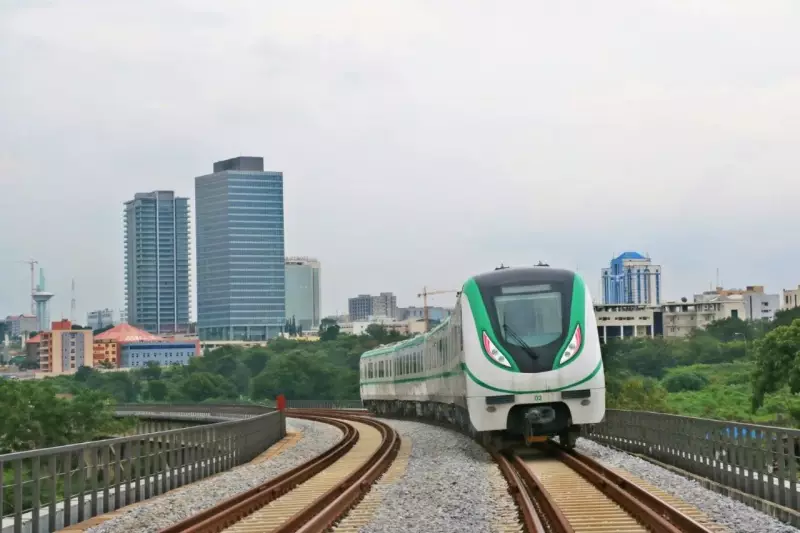
The Managing Director of the Nigerian Railway Corporation (NRC), Dr. Kayode Opeifa, has pinpointed persistent and severe underfunding as the single most significant obstacle preventing the growth and modernization of Nigeria's rail system. He made these revelations during a frank discussion on The Exchange Podcast, hosted by Femi Soneye.
Rail as a Dual-Priority Sector
Dr. Opeifa reframed the narrative around sectoral problems, stating that what many call 'challenges' are simply 'issues' that human intellect is designed to solve. However, when pressed to identify the core bottleneck, he was unequivocal: "funding is key." He passionately argued that a robust railway network is a fundamental pillar distinguishing developed nations from developing ones.
He lamented that despite its proven impact on reducing poverty and spurring broad economic development, the rail sector consistently fails to receive the budgetary priority it deserves from national resource managers. "Mobility is what many countries in the world focus on," Opeifa stated, explaining that enabling the free movement of people for trade and business creates a ripple effect of benefits across the entire economy.
A Call for a Paradigm Shift in Investment
The NRC boss made a critical appeal for the government to start viewing rail infrastructure through a dual lens: as both an economic and a social sector. He explained that this classification is crucial because a purely commercial perspective fails to capture the broader societal value of railways.
This value includes significantly reduced road congestion, fewer traffic accidents, and a smaller environmental footprint through lower emissions. Opeifa warned that without this understanding, "the economic people will not put money," dooming the sector to a continued cycle of capital starvation that prevents meaningful expansion and upgrades.
Proof of Potential and Praise for Support
Despite the funding challenges, Dr. Opeifa expressed strong commendation for President Bola Ahmed Tinubu, acknowledging that the current administration has provided the NRC with significant support. He followed this praise with an appeal for "more support, more money and more understanding from those who are managing the economy."
To bolster his argument for increased investment, he pointed to recent data from the National Bureau of Statistics (NBS). The data listed rail transport as one of the top 10 contributors to Nigeria's GDP growth in recent quarters, recording an impressive 37 per cent year-on-year increase. He presented this statistic as tangible, irrefutable proof of the sector's massive economic potential when properly funded.
Addressing concerns about technical capacity, Opeifa firmly stated that the NRC's engineers are fully capable of maintaining and building rail systems. Their efforts, however, are severely hampered by a lack of financial resources. In a bold promise, he revealed that if adequate funding were secured to fully optimize the Lagos-Kano line, the NRC could transform it into a "supercharged and working" line for all Nigerians within a remarkably short timeframe of just three to six months.




