
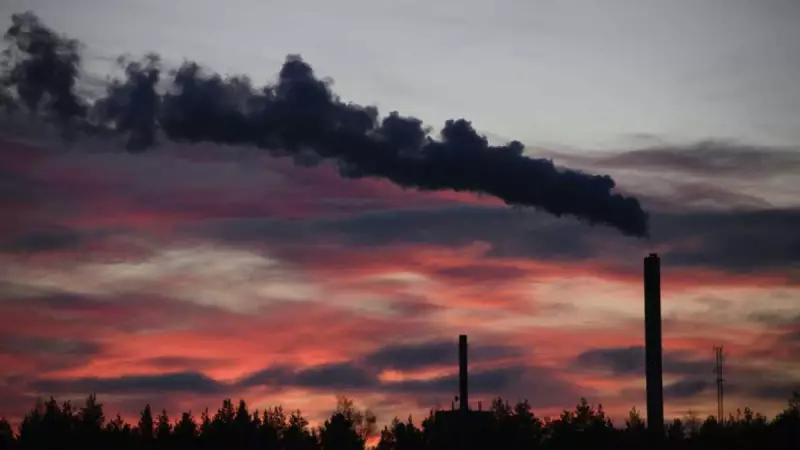
Global fossil fuel emissions are projected to reach unprecedented levels in 2025, according to a sobering new climate study released during COP30 talks in Brazil. The research indicates that limiting global warming to 1.5°C above pre-industrial levels has become essentially impossible given current emission trends.
Record Emissions Despite Renewable Growth
The annual Global Carbon Budget report, published in Earth System Science Data, reveals that CO2 emissions from fossil fuels will be 1.1 percent higher in 2025 compared to 2024 levels. This increase comes despite significant global investments in renewable energy technologies.
According to the international team of scientists behind the study, the massive rollout of clean energy solutions worldwide has not been sufficient to offset growing energy demand. The research examined humanity's emissions of planet-heating CO2 from multiple sources including:
- Burning of hydrocarbons
- Cement production
- Land use changes including deforestation
The overall emissions figure is expected to reach a staggering 38.1 billion tonnes of CO2 in 2025, with emissions from oil, gas, and coal all projected to rise.
Closing Window for Climate Action
The study calculated that only 170 billion tonnes of CO2 remain in the global carbon budget to limit warming to the Paris Agreement's 1.5°C target. At current emission rates, this budget will be exhausted within just four years.
Pierre Friedlingstein of Britain's Exeter University, who led the research, stated unequivocally: "This equates to four years of emissions at the current rate before the budget for 1.5°C is exhausted, so that is impossible, essentially."
The findings cast a shadow over the COP30 climate talks taking place in the rainforest city of Belem, Brazil. The conference is proceeding without participation from the United States, the world's second-largest polluter.
Mixed Progress Across Major Economies
The report reveals varying emission trends across different regions and countries:
In China, the world's largest carbon polluter, fossil emissions remained largely flat this year, particularly from highly polluting coal. However, researchers caution that policy uncertainty makes it too early to declare the country has reached its emissions peak.
Glen Peters of the CICERO Center for International Climate Research noted: "The balance is shifting towards where you would start to expect emissions to go down, but it will take some time."
The United States saw coal emissions rise by 7.5 percent, attributed to higher gas prices that prompted power generators to switch to the more polluting fuel. Both the US and European Union bucked recent downward emission trends, partly due to cooler winter months increasing heating demand.
India recorded a smaller CO2 increase than in recent years, helped by an early monsoon and strong renewable energy growth.
Despite the overall grim outlook, the study identified some positive developments. Thirty-five countries have successfully reduced their emissions while growing their economies—twice as many as achieved this feat a decade ago.
Humanity's total emissions, including those from land use, were projected to reach 42.2 billion tonnes this year—slightly lower than 2024 levels, though researchers noted this figure comes with significant uncertainty.
The failure to cut planet-heating emissions comes despite indications that 2025 will be one of the hottest years ever recorded. Nations' collective climate plans have fallen far short of what's needed, with Peters emphasizing: "Collectively, the world is not delivering. Everyone needs to do their bit, and all of them need to do more."




