
In a powerful address that resonated across international borders, Pope Leo XIV has issued a grave warning about the escalating global conflicts that threaten humanity's very existence. The pontiff delivered this urgent message during his first overseas trip since assuming leadership of the Catholic Church.
Historic Visit to Turkey Amid Regional Tensions
The Pope arrived in Ankara on Thursday, where he was warmly received by Turkish President Recep Tayyip Erdogan. This significant six-day journey, which also includes Lebanon, marks the American pope's inaugural diplomatic tour since his election in May. The timing of his visit coincides with heightened tensions in the region, particularly the ongoing conflicts in Gaza.
Speaking at the Presidential Palace in Ankara, Pope Leo did not mince words about the current global situation. "We are now experiencing a phase marked by heightened level of conflict on the global level, fueled by prevailing strategies of economic and military power," he told assembled civic leaders and lawmakers.
Stark Warning About World Order
The pontiff expressed deep concern about the destabilization of world order, attributing it to "ambitions and choices that trample on justice and peace." He specifically referenced his predecessor Pope Francis's characterization of the current situation as "a Third World War fought piecemeal."
In what many observers described as his most forceful statement yet, Pope Leo declared, "We must in no way give in to this. The future of humanity is at stake." This stark assessment underscores the gravity with which the Vatican views current global conflicts.
Regional Leaders Echo Concerns
President Erdogan strongly supported the Pope's message, noting that the visit came at a "highly critical time" given regional wars. The Turkish leader specifically mentioned the ongoing attacks in Gaza and referenced a deadly strike on the only Catholic church in the Palestinian enclave that occurred in July.
Erdogan praised Pope Leo's "strong stance" on advocating for Palestinian dignity and human rights. He echoed the pontiff's calls for immediate action, stating, "The ceasefire reached in Gaza must be reinforced, the safety of civilians must be guaranteed, and humanitarian aid must reach Gaza without any interruptions."
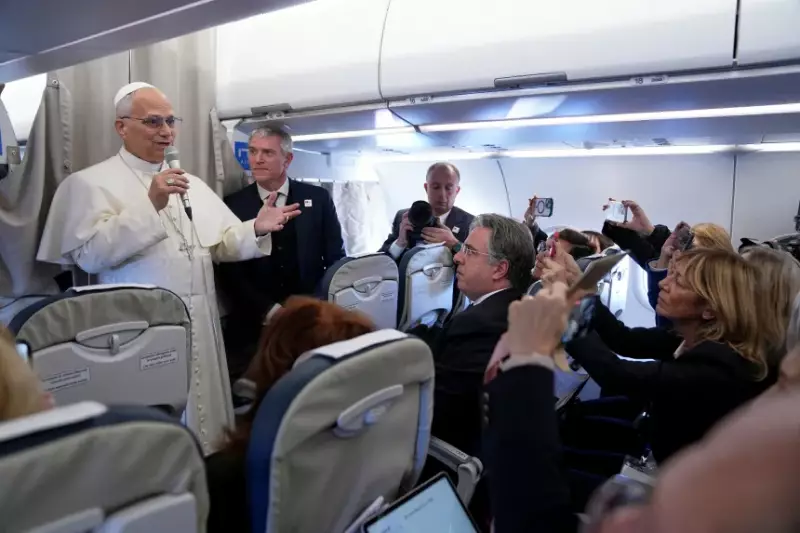
Earlier in the day, while aboard his papal plane, Pope Leo took time to wish Americans a happy Thanksgiving and acknowledged journalists for their crucial role in today's world. He emphasized that "it is so important today that the message be transmitted in a way that really reveals the truth and harmony that the world needs."
Mission of Peace and Unity
The Pope clarified that his visit to Turkey and Lebanon focuses primarily on "unity" and "peace." He expressed his determination "to look for the ways all men and women can surely be brothers and sisters in spite of differences, in spite of different religions, in spite of different beliefs."
This mission takes on particular significance given that both Turkey and Lebanon have majority Muslim populations while also hosting ancient Christian communities. The timing is especially poignant for Lebanon, as Pope Leo's visit to Beirut follows recent bombings by Israel's military on the Lebanese capital.
The first day of the papal trip included several symbolic gestures, including laying a wreath at Ataturk's mausoleum, the final resting place of Mustafa Kemal Ataturk, the founder of modern Turkey. The Pope also visited the Diyanet, Turkey's Presidency of Religious Affairs, and met with the country's chief rabbi before departing Ankara for Istanbul.
In Istanbul, Pope Leo is scheduled to meet with Ecumenical Patriarch Bartholomew, the spiritual leader of the Eastern Orthodox Church. This significant ecumenical encounter forms part of celebrations marking the 1,700th anniversary of the Council of Nicaea, which established core Christian beliefs. The celebrations are taking place in modern-day Iznik, northwestern Turkey, where the historic council convened in 325 AD.
As global tensions continue to escalate, Pope Leo XIV's message serves as both a warning and a call to action for world leaders and citizens alike to prioritize peace and human dignity above political and military ambitions.




