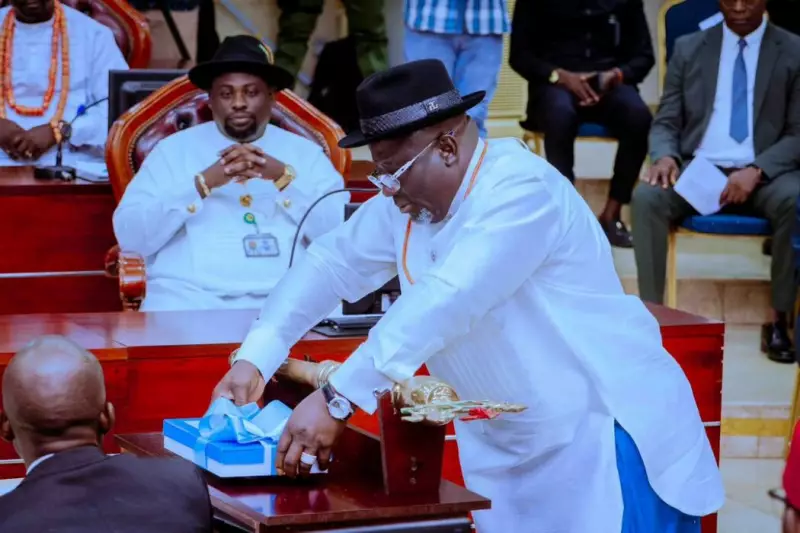
Governor Sheriff Oborevwori of Delta State has officially presented a massive N1.664 trillion Appropriation Bill for the 2026 fiscal year to the Delta State House of Assembly. The budget, which was presented on Wednesday, November 27, 2025, marks a significant commitment to infrastructure expansion, with a bold 70 percent of the total sum dedicated to capital expenditure.
A Budget for Accelerated Development
Christened the "Budget of Accelerating the More Agenda," the proposal was presented at the hallowed chamber of the Assembly Complex in Asaba, in accordance with Section 121 of the 1999 Constitution. Governor Oborevwori stated that the budget was designed to leverage an improving national economy, with Nigeria's GDP projected to grow by 3.9% in 2026.
He pointed to several positive economic indicators, including rising oil revenues, stabilizing fiscal and monetary policies, ongoing tax reforms, and federal efforts to tackle insecurity, as reasons for optimism. The governor explained that the 2026 budget is strategically crafted to drive inclusive growth, develop human capital, renew infrastructure, and ensure better management of state resources.
Revenue Expectations and Fiscal Discipline
A detailed breakdown of the budget reveals a clear focus on capital projects. Out of the total N1.664 trillion, a substantial N1.165 trillion (70%) is earmarked for capital expenditure, while N499 billion (30%) is allocated for recurrent spending. This capital allocation represents a 70% increase compared to the 2025 appropriation.
On the revenue side, the state anticipates a significant boost from federal allocations following the removal of the fuel subsidy. Statutory Allocation, including mineral derivation, is projected at N720 billion, making up 43.28% of the total revenue and reflecting a 23.75% rise from the previous year.
Furthermore, reforms in Internally Generated Revenue (IGR) are expected to yield N250 billion in 2026, an impressive 86.5% increase, driven by more professional revenue collection processes. The state also projects N120 billion from VAT remittances and N489 billion from savings and oil revenue recoveries, which the governor attributed to his administration's "fiscal discipline and prudence." Notably, capital receipts are reduced to N25 billion as the state aims to maintain a zero-borrowing posture.
Key Sectoral Allocations and Priorities
The budget outlines specific allocations to critical sectors, underscoring the administration's development priorities.
The Works Ministries, covering Urban Highways and Rural and Riverine Roads, are set to receive a joint allocation of N450 billion. This massive investment is aimed at accelerating strategic road development across the state.
The education sector is allocated N105.086 billion to strengthen access to quality learning, while the health sector gets N50.067 billion. The health funds are designated for improving infrastructure across the state's extensive network of 441 primary healthcare centres, 65 general hospitals, and three tertiary facilities.
For recurrent expenditure, personnel costs are estimated at N185 billion, overheads at N204 billion, and N110 billion is allocated for social contributions, benefits, and grants. The governor emphasized that these figures account for current inflationary trends and reaffirm the state's commitment to the welfare of its workforce.