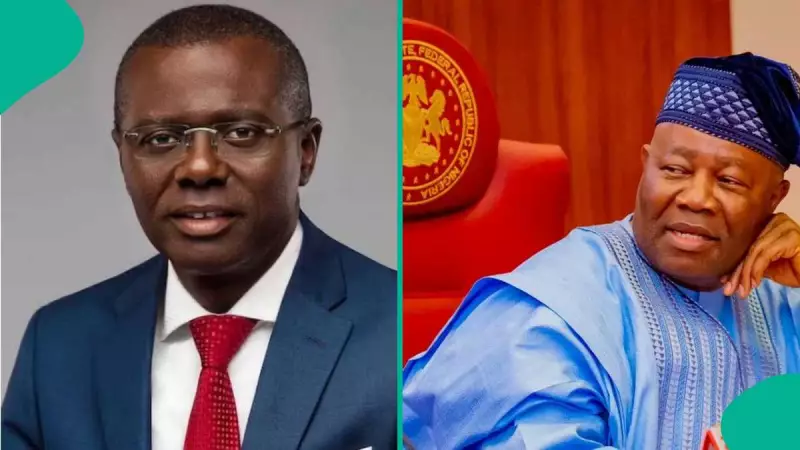
The Lagos State Government has escalated its legal battle with the National Assembly by approaching the Supreme Court for permission to initiate contempt proceedings against federal lawmakers. This dramatic move comes in response to the proposed Central Gaming Bill, which Lagos claims blatantly violates a landmark 2024 Supreme Court judgment that declared federal control over lottery and gaming unconstitutional.
Constitutional Clash Over Gaming Regulation
In a motion filed by the Attorney-General and Commissioner for Justice, Mr. Lawal Pedro, SAN, Lagos State is seeking leave to enforce the Supreme Court's ruling through Form 48 - a legal notice that serves as a formal warning under Nigerian law. If ignored, this could potentially lead to committal to prison for those found in contempt of court.
The state's legal team, led by prominent lawyer Bode Olanipekun (SAN), argues that the National Assembly's ongoing review of the proposed Central Gaming Bill directly contravenes the apex court's decision in SC.1/2008: Attorney-General of Lagos State & Ors. v. Attorney-General of the Federation & Ors., delivered on November 22, 2024.
Specific Legal Objections to the Bill
Lagos State has identified several problematic sections in the proposed legislation. According to the affidavit filed with the Supreme Court, clauses 7 and 21-64 specifically deal with lottery and gaming matters, despite the court's clear ruling that such issues fall outside federal legislative powers.
The state's legal documents highlight that these contentious clauses closely resemble provisions in the now-voided National Lottery Act, which the Supreme Court struck down in its 2024 judgment. Both the invalidated law and the new bill define "lottery" and "online gaming" in similar terms, covering games of chance or skill that require licensing.
Particular attention was drawn to Clause 62 of the bill, which aims to preserve actions taken under the nullified law. Lagos State describes this provision as "a deliberate attempt to undermine the Supreme Court's authority" and a clear violation of the constitutional separation of powers.
Broader Implications for Nigerian Federalism
Legal experts following the case suggest this confrontation could have far-reaching consequences for Nigeria's federal structure. The move by Lagos State represents a significant test of judicial authority and could potentially redefine the limits of federal power in relation to state jurisdictions.
Lagos emphasized in its legal arguments that since the 2024 judgment, no changes have been made to the Second Schedule of the 1999 Constitution, which outlines the Exclusive and Concurrent Legislative Lists, to include lottery or gaming. This constitutional silence, the state argues, confirms that such matters properly remain under state control.
The Supreme Court's original landmark ruling had explicitly rejected claims that federal authority over gaming could be inferred from Item 62 (trade and commerce) or the interstate nature of gaming operations, making the National Assembly's current actions particularly contentious.
This legal showdown represents one of the most significant tests of constitutional authority in recent years and could establish important precedents for future disputes between state and federal governments in Nigeria. The outcome will be closely watched by legal experts, state governments, and federal authorities across the country.