
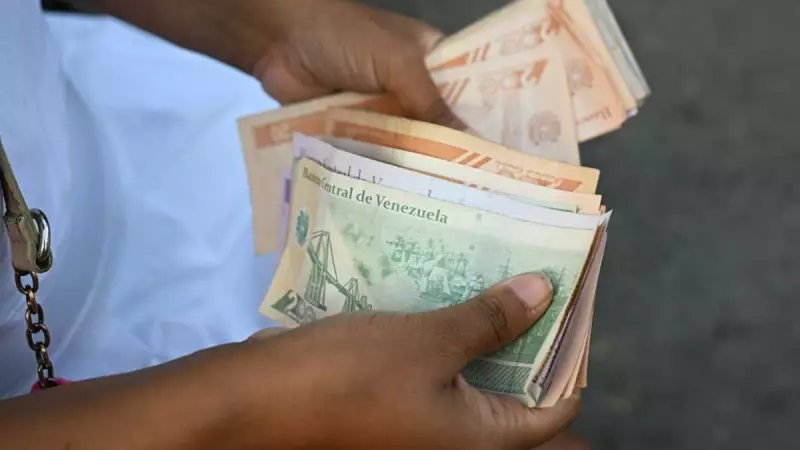
Venezuela's Economy Spirals Toward Hyperinflation Nightmare
The International Monetary Fund has issued alarming projections for Venezuela's economy, forecasting an inflation rate of 548 percent for 2025 and an even more devastating 629 percent for 2026. These staggering numbers signal a potential return to the dark days of hyperinflation that previously crippled the South American nation.
Daily Struggle for Survival
Ordinary Venezuelans are feeling the crushing weight of economic collapse in their daily lives. Citizens increasingly live hand to mouth, purchasing basic food items like tomatoes and onions in small quantities as they manage to scrape together enough bolivars for essential needs.
"If we earn 20 bolivars, we need 50," lamented Jacinto Moreno, a 64-year-old informal merchant in downtown Caracas. The economic reality has become so dire that buying a single kilogram of tomatoes requires the equivalent of one US dollar, while the average monthly salary amounts to only a few hundred dollars.
Norma Guzman, a 66-year-old office cleaner, exemplifies the struggle facing Venezuelan families. She can no longer afford to purchase groceries monthly or even weekly. "I shop daily," she explained after leaving a store with nothing but three tomatoes, describing how she, her husband, and their son must buy food whenever they manage to set aside enough money.
Historical Context and Current Crisis
Venezuela has already experienced the world's highest inflation rate multiple times, with memories remaining fresh of the record 130,000 percent year-on-year price increase recorded in 2018. That period marked the peak of a four-year hyperinflationary crisis that pushed millions of Venezuelans to emigrate and only technically ended in 2021.
The current situation shows alarming parallels. The bolivar has lost nearly 400 percent of its value against the US dollar so far this year alone. Meanwhile, President Nicolas Maduro's government has stopped publishing official inflation figures since October 2024, following his controversial election victory that many international observers consider illegitimate.
President Maduro claims inflation reached 48 percent in 2024, but independent economists paint a much grimmer picture. Oscar Torrealba, a Colombian-based Venezuelan economist, expects inflation to soar above 800 percent - significantly higher than IMF projections.
Political and Economic Factors
President Maduro consistently blames US sanctions for Venezuela's economic collapse. He also accuses Washington of seeking to depose him and seize control of the country's vast oil deposits, pointing to the deployment of US warships in the Caribbean for anti-drug operations as evidence of this agenda.
Despite the economic turmoil, Maduro has made optimistic predictions about Venezuela's economic future, claiming the country will register GDP growth of over nine percent in 2025. The International Monetary Fund strongly contradicts this assessment, projecting growth of only 0.5 percent for the same period.
The situation for economic analysts within Venezuela remains precarious. Few economists still living in the country dare to publicly challenge the official government line, especially after several of their peers - including a former finance minister - were detained earlier this year.
Dollar Shortage Worsens Crisis
Unlike previous economic crises, the current steep price increases haven't resulted in widespread product shortages - at least not yet. This relative availability stems from Maduro's earlier decision to decriminalize use of the US dollar, which has become Venezuela's de facto currency, along with halting money printing and relaxing exchange controls.
However, the country now faces a critical shortage of US dollars, which many Venezuelans try to save as insurance against the bolivar's continuous devaluation. A major source of foreign currency has dried up as US oil giant Chevron, operating under a special license despite sanctions, no longer pays royalties in cash but instead pays in crude oil that the state must sell at a discount.
With fewer dollars circulating in the market, the gap between the official exchange rate and the informal rate has widened to over 60 percent, according to financial analysts. This dollar scarcity compounds the economic pain for ordinary citizens already struggling with skyrocketing prices and stagnant incomes.
As Venezuela stands on the brink of another hyperinflationary period, the international community watches with concern while Venezuelan citizens continue their daily battle for economic survival in one of the world's most challenging economic environments.




