
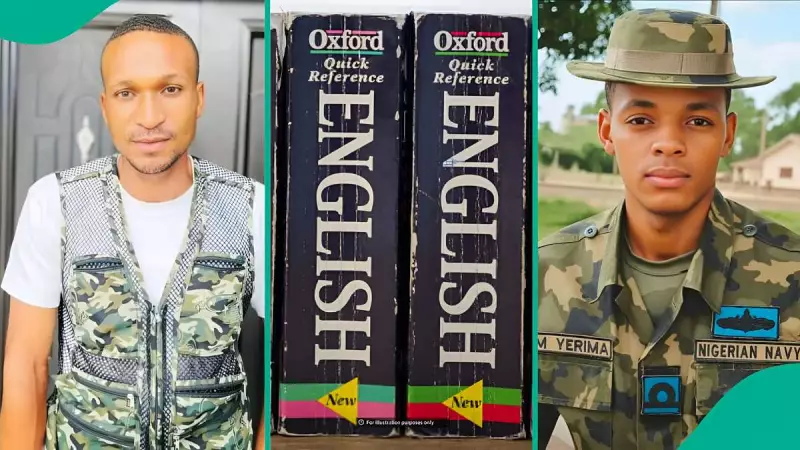
A Nigerian man has captured national attention with his bold request to Oxford Dictionary to include the name of viral naval officer Lieutenant Yerima as a new English word. The social media user made his case through a detailed Facebook post that has since gone viral across various platforms.
The Viral Proposal for Oxford Dictionary
Amid the ongoing social media frenzy surrounding Lieutenant Yerima's confrontation with Federal Capital Territory Minister Nyesom Wike, a Facebook user identified as Bamijoko Kayode Oto took to the platform with an unconventional linguistic proposal. In his November 19, 2025 post, he argued that Yerima deserves recognition in the Oxford Dictionary given the officer's recent prominence in Nigerian public discourse.
The man wrote emphatically: "Since YERIMA has been the most mentioned name in Nigeria these past days, I think the Oxford Dictionary should consider creating a space for him in the dictionary." His statement came as Lieutenant Yerima continued trending days after his widely shared encounter with Minister Wike.
Comprehensive Grammatical Framework
What made the post particularly remarkable was the detailed grammatical structure the proposer outlined for incorporating "Yerima" into English usage. He provided five distinct linguistic applications that demonstrate how the term could function across different grammatical contexts.
He began by defining the adjective form: "YERIMA: /ye-ri-ma/ adjective: dignity, integrity, defence." This establishes the core meaning he associates with the viral officer's name.
The proposal then expanded to verb forms, suggesting:
Verb: yerima
Past Tense: yerimied
Present Continuous: yeriming
Present Perfect: yerimied
Practical Usage Examples
To demonstrate how his proposed word would function in everyday communication, the Facebook user provided multiple contextual examples that quickly resonated with Nigerian social media users.
He illustrated practical applications with sentences like: "I yerimied my uncle from entering our farmland" and "I've been yerimied from school because of my school fees." Another example showed protective usage: "It's God that yerimied me; I could have been hit by that car."
The proposer further clarified that Yerima means "to save things, to oppose things, to defend things" and provided additional examples including "If that babe comes, yerima her from entering the compound" and "Access Bank just yerimied my account." Even sports applications were covered with "The goalkeeper yerimied the ball very well" and domestic uses with "Don't yerima the door; let fresh air come in."
Social Media Reactions and Engagement
The creative linguistic proposal sparked immediate and enthusiastic responses across social media platforms. Facebook users flooded the comment section with both humorous engagement and genuine appreciation for the innovative concept.
User Noni commented: "Why i yerimied him is because he is talking when am talking." while Destiny responded: "You dey too much. I was so much yerimed seen this your post."
Friday praised the creativity: "Is like you participated in writing the oxford dictionary. I swear this one enter. Thanks for making us laugh." Meanwhile, Chris offered grammatical refinement: "D past tense can't be YERIMIED cos it has no Y to break into 'ies ied' as a Scrabble player what likely will form d past tense is YERIMA to ED which is YERIMAED, YERIMAING..."
The engagement demonstrated how the proposal had captured public imagination, with user Sylva noting: "Na so God dey lift people ooo, this young man don go viral for good. God yerimied him into going viral."
Broader Cultural Context
This linguistic innovation emerges against the backdrop of Lieutenant Yerima's viral confrontation with Minister Wike, which has spawned numerous social media trends and creative expressions. From individuals printing the scene on T-shirts to family members and classmates sharing their perspectives, the Yerima phenomenon has become a significant cultural moment in Nigeria.
The proposal to Oxford Dictionary represents one of the most creative responses to the viral incident, demonstrating how social media users are finding innovative ways to engage with current events. It also highlights the dynamic nature of language evolution in the digital age, particularly how Nigerian English continues to develop and incorporate local references.
While Oxford Dictionary has not publicly responded to the proposal, the viral post has succeeded in sparking nationwide conversation about language, creativity, and how contemporary events influence linguistic development. The incident shows how social media can serve as a platform for ordinary citizens to participate in shaping language and cultural discourse.