
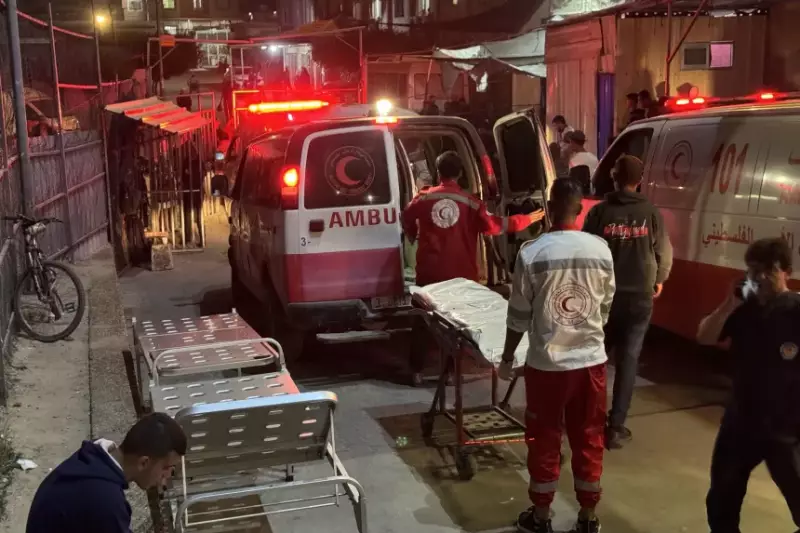
Israeli military strikes across the Gaza Strip have resulted in the deaths of at least 28 Palestinians on Wednesday night, marking the latest escalation of violence since the ceasefire between Israel and Hamas took effect.
Casualties and Conflicting Accounts
The Israel Defense Forces (IDF) confirmed conducting strikes on Hamas targets after what they described as "several terrorists" firing on Israeli soldiers operating in Khan Younis in southern Gaza. The military stated this action violated the ceasefire agreement, though no Israeli forces were injured during the incident.
However, Hamas strongly condemned the strikes, labeling them as "a dangerous escalation" and completely rejecting the IDF's version of events. The group accused Israel of attempting to justify what they called "ongoing crimes and violations" against the Palestinian people.
According to health officials in the enclave, nine children were among those killed in Wednesday's strikes, with at least 77 others sustaining injuries. The deadliest attack occurred in the Zaytun area in eastern Gaza, where Gaza Civil Defense reported 10 fatalities, including a woman and a child.
Targeted Areas and International Response
Another significant strike hit an area west of Khan Younis, targeting what witnesses described as "a group of civilians inside the UNRWA club" - referring to the United Nations Relief and Works Agency for Palestine Refugees in the Near East.
Hamas has called upon the United States to exert "immediate, serious pressure" on Israel to respect the ceasefire and halt what they term aggression against Palestinian civilians. This appeal comes just days after the UN Security Council endorsed US President Donald Trump's plan for moving beyond the fragile truce toward sustainable peace and reconstruction of the devastated territory.
Broader Regional Context
This represents the third major escalation since the ceasefire agreement came into force in October, with each incident preceded by attacks on Israeli soldiers. Previous escalations resulted in approximately 150 Palestinian deaths and three Israeli soldier fatalities, though the ceasefire has largely held despite these violations.
The current conflict traces back to October 7, 2023, when Hamas-led militants killed around 1,200 people and took more than 250 hostages during an attack on Israel. Since then, the Gaza health ministry reports that more than 69,000 Palestinians have been killed, with women and children comprising the majority of casualties.
As part of the initial phase of the US-brokered ceasefire framework, Hamas agreed to release all remaining hostages in Gaza, both living and deceased, while Israel committed to withdrawing from some Gaza areas and releasing Palestinian prisoners. Hamas has since released all living hostages and the bodies of all but three deceased captives.
Simultaneously, Israel conducted airstrikes on what it identified as Hezbollah weapons storage sites in southern Lebanon. These strikes follow an Israeli attack on a Palestinian refugee camp in Lebanon that killed 13 people according to Lebanon's health ministry. The IDF claimed Tuesday's strike targeted "a Hamas training compound" used for planning terrorist attacks against Israel.
Wednesday's additional strikes in southern Lebanon focused on what Israel described as "several weapons storage facilities belonging to Hezbollah's rocket unit". While causing no casualties according to Lebanon's state-run National News Agency, the attacks damaged several houses.
Israel has maintained strikes in Lebanon targeting militants from Hezbollah and various Palestinian factions for over two years, with escalations occurring after Iran-backed Hezbollah launched attacks supporting Hamas following the October 7 incident. The latest military actions occur despite a ceasefire agreement between Israel and Hezbollah that took effect in November 2024.




