
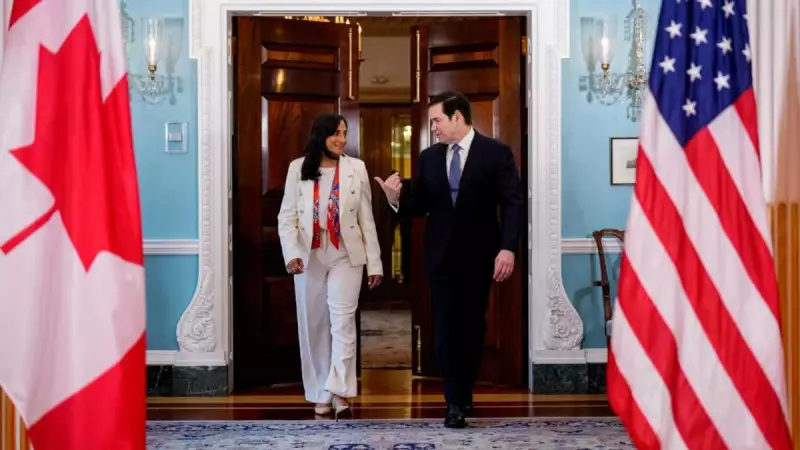
Foreign ministers from the world's leading industrialized nations, the Group of Seven (G7), have convened in Canada for critical discussions aimed at bolstering support for Ukraine and reducing global reliance on China for essential minerals.
Ukraine's War Needs Take Center Stage
The two-day gathering, which began on Tuesday in Canada's Niagara region, is expected to heavily focus on finding sustainable ways to fund Ukraine's defence against ongoing Russian aggression. This comes after the country has endured devastating attacks on its energy infrastructure.
The diplomatic push follows recent actions by US President Donald Trump, who in October imposed sanctions on Moscow's two largest oil companies. President Trump has been vocal in criticising Russian President Vladimir Putin's refusal to end the conflict and has pressured European nations to stop purchasing oil that finances Moscow's war machine.
While the urgency to aid Kyiv is clear, Canadian Foreign Minister Anita Anand, who is hosting the talks, tempered expectations of immediate concrete outcomes. She emphasised to AFP that a key priority for Canada is to broaden the conversation beyond the core G7 nations.
A Broader Multilateral Approach
In a significant move to foster wider consensus, the meeting includes representatives from major global economies outside the G7. Diplomats from Saudi Arabia, India, Brazil, Australia, South Africa, Mexico, and South Korea are also participating in the discussions.
"For Canada, it is important to foster a multilateral conversation, especially now, in such a volatile and complicated environment," Anand stated, highlighting the need for a united international front.
US Secretary of State Marco Rubio is scheduled to hold bilateral talks with Minister Anand on Wednesday, the final day of the summit. Notably, Anand indicated that the contentious issue of Trump's trade war, which has negatively impacted Canadian jobs and economic growth, would not be a primary focus. She confirmed that trade matters are being handled by other ministerial channels.
Confronting China's Critical Mineral Dominance
Another major item on the agenda is addressing China's commanding control over the supply chains for critical minerals. This topic follows a meeting two weeks prior where G7 energy secretaries agreed on further steps to counter Beijing's dominance.
China has established a powerful market position in the refining and processing of various minerals, particularly the rare earth materials essential for manufacturing high-tech magnets used in advanced technologies.
In a direct response, the G7 announced an initial series of joint projects last month aimed at ramping up refining capacity that explicitly excludes China. Although the United States was not part of these initial deals, the Trump administration has signalled its alignment with the strategy of its G7 partners.
A US State Department official, speaking ahead of the Niagara meeting, confirmed that securing critical mineral supply chains would be "a major point of focus," adding that "There's a growing global consensus amongst a lot of our partners and allies that economic security is national security."
The outcomes of these high-stakes discussions are being closely watched, as they have significant implications for global security, economic stability, and the technological race.




