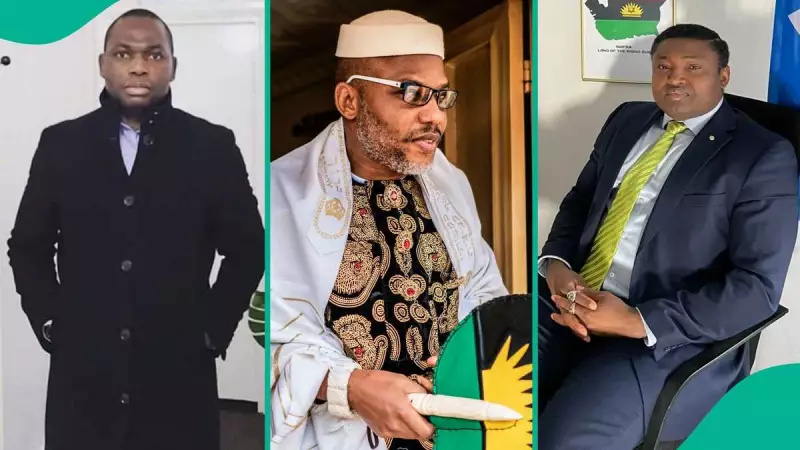
Nigeria's judiciary has recently intensified its crackdown on separatist movements, with three prominent secessionist activists receiving prison sentences for their involvement in promoting ethnic division and terrorism activities. The most notable case involves Nnamdi Kanu, leader of the proscribed Indigenous People of Biafra (IPOB), who received multiple sentences including life imprisonment.
Recent Secessionist Sentencings
Nnamdi Kanu, the controversial IPOB leader, was handed down severe punishments by the Federal High Court on Thursday, November 20. The court sentenced him to life imprisonment on Counts 1, 4, 5 and 6, all connected to terrorism-related offences. Additionally, he received 20 years imprisonment on Count 3 and 5 years on Count 7, with none of the sentences carrying an option for fine payment.
The court imposed strict restrictions on Kanu's access to digital services, including phones, laptops, and tablets. According to the ruling, the National Security Adviser (NSA) will have complete discretion over whether Kanu can access any electronic communication devices during his incarceration.
Other Convicted Separatists
Simon Ekpa, the Finnish-Nigerian separatist leader, received a six-year prison sentence from the Paijat-Hame District Court in Finland. The court found Ekpa guilty of participating in a terrorist organization and publicly inciting crimes for destructive purposes. Ekpa leads the 'Autopilot' faction within IPOB, which continues to advocate for a breakaway state in southeastern Nigeria, reminiscent of the briefly independent Biafra state of the late 1960s.
Adeyinka Grandson, based in the United Kingdom and convener of Young Yorubas for Freedom (YYF), was sentenced to four and a half years in prison for promoting racial hatred. His legal troubles began with his arrest in London in August 2019 following inflammatory social media posts targeting Igbo and Hausa-Fulani ethnic groups. The situation escalated in October 2020 when he appeared in a video issuing a 48-hour ultimatum to Igbo residents in Yorubaland to leave the region, prompting condemnation from Nobel laureate Wole Soyinka.
Historical Context of Secessionist Movements
Nigeria's history with secessionist agitation dates back to soon after independence, when such movements ultimately led to the country's devastating civil war. The conflict lasted for two and a half years and resulted in the deaths of thousands of people, including numerous children and women.
As a multi-ethnic and multi-religious nation, Nigeria continues to face various secessionist pressures, though the current constitution lacks any secession clause. Interestingly, many contemporary agitators operate from the diaspora, and there appears to be limited pressure on lawmakers to address constitutional changes regarding secession despite periodic constitutional reviews.
The recent convictions demonstrate the Nigerian government's firm stance against separatist movements and its commitment to preserving national unity through legal means. These cases highlight the ongoing challenges Nigeria faces in balancing ethnic diversity with national cohesion in its complex political landscape.