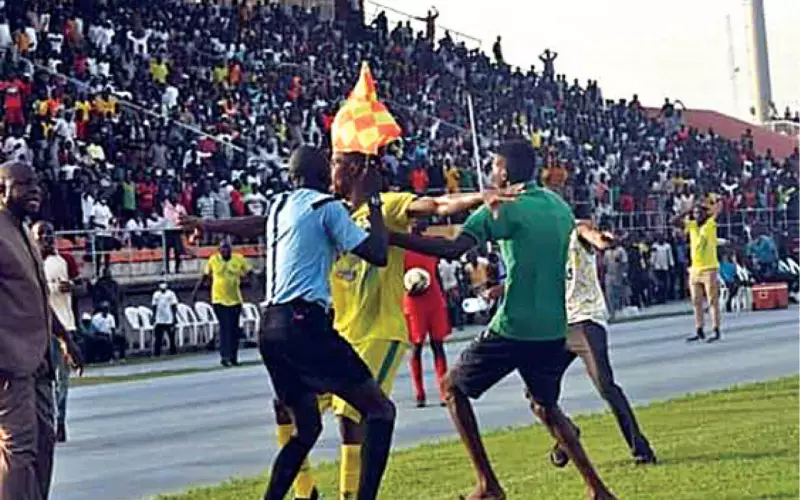
The Nigerian Professional Football League is facing a severe crisis as violent attacks on players and match officials become increasingly common, driving away families and threatening the very survival of domestic football.
From Community Celebration to War Zones
Football stadiums in developed nations serve as family-friendly spaces where communities gather to enjoy their favorite sport. In England, for instance, match days are social events filled with banter and camaraderie.
Nigeria once enjoyed a similar thriving football culture during the 1970s, when teams like Enugu Rangers, IICC Shooting Stars of Ibadan, and Stationery Stores of Lagos commanded loyal fan bases that traveled extensively without causing trouble.
Today, however, many Nigerian league venues have transformed into dangerous spaces where families no longer feel safe attending matches.
Recent Violent Incidents Shock NPFL
The severity of the situation became alarmingly clear during a Week 12 match at Muhammadu Dikko Stadium, where outraged Katsina United fans stormed the pitch to attack visiting Barau FC players.
Barau FC player Nana Abraham suffered serious neck injuries after being struck by a dangerous object thrown from the stands. The violence erupted simply because the visiting team dared to score an equalizing goal against the home side.
This incident occurred barely three weeks after similar violence marred Kano Pillars' Match Day Eight fixture against Shooting Stars Sports Club (3SC) of Ibadan at Sani Abacha Stadium.
NPFL's Response and Stakeholder Criticism
The league organizers responded to the Katsina United incident by imposing a N9 million fine and banishing the club to New Jos Township Stadium, where they must play home matches behind closed doors indefinitely.
Kano Pillars received even harsher punishment: a N9.5 million fine, deduction of three points and three goals, plus indefinite closure of their home stadium.
However, stakeholders argue these measures remain insufficient. Napoleon Aluma, former head coach of Warri Wolves, stated: "Hooliganism persists because the NFF and NPFL have been lenient with clubs and have shied away from enforcing their rules."
Aluma contrasted Nigeria's situation with England's successful crackdown on football violence, noting: "Today, the English Premier League is the most-watched league in the world. They don't cage fans as if they are animals. Have you heard of any hooligans in England in the last 20 years?"
The Way Forward for Nigerian Football
Emmanuel Ujah, Media Officer of Lobi Stars, identified inadequate punishment and weak enforcement as major contributors to the problem. "If any team breaches the rule, that team should face heavy punishment. Why should anybody jump into the field and unleash mayhem? That's barbaric behavior," he emphasized.
Chikelue Iloenyosi, Anambra FA Chairman and former Super Eagles defender, proposed a straightforward solution: "Once a fan identifies with a club and causes trouble, the club should bear responsibility. These clubs know their fans and sometimes instigate them."
Defending the NPFL's efforts, Chief Operating Officer Davidson Owumi described the challenge as "hydra-headed" and acknowledged that some elements resist the positive changes in domestic football. "We are doing our best to make sure everybody comes to the same standard," he assured.
Unless stricter measures including prosecution and stadium bans for violent fans are implemented, the few remaining spectators brave enough to attend matches may soon disappear entirely, dealing a fatal blow to Nigeria's domestic league.