
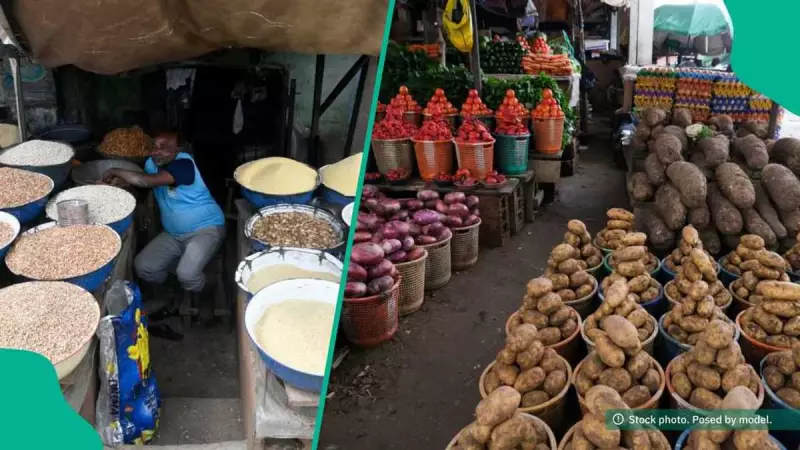
The National Bureau of Statistics has delivered welcome news to Nigerian households, reporting noticeable decreases in the prices of essential food commodities during September 2025. According to the latest data, staples including beans, garri, maize, and tomatoes have become more affordable, offering some relief to consumers grappling with food inflation.
Significant Price Reductions Across Key Staples
The NBS Selected Food Prices Watch report revealed substantial year-on-year declines for several fundamental food items. Brown beans experienced the most dramatic drop, with prices falling by 33.70 percent compared to September 2024. The average cost per kilogram decreased from N2,738.59 to N1,815.76, representing significant savings for Nigerian families who rely on this protein-rich staple.
White garri followed this positive trend, becoming 25.51 percent cheaper than the previous year. Consumers paid an average of N871.78 per kilogram in September 2025, down from N1,170.25 during the same period in 2024. The monthly comparison showed even better news, with prices dropping by 6.52 percent from August's N932.53.
Maize prices also eased considerably, with a kilogram of loose white maize costing 16.57 percent less than September 2024. The commodity's price fell from N1,065.14 to N888.68, while month-on-month data showed a 6.56 percent reduction from August's N951.04.
Tomato prices joined the downward movement, recording a 10.56 percent year-on-year decline. The average price decreased from N1,430.87 to N1,279.84 per kilogram, with a marginal 0.45 percent monthly reduction from August's N1,285.61.
Mixed Performance for Rice and Beef
Not all food items followed the declining price pattern. Local rice bucked the trend by recording a marginal year-on-year increase of 1.99 percent. The average price rose from N1,914.77 in September 2024 to N1,952.94 in September 2025. However, month-on-month data showed a slight 0.56 percent decrease from August's N1,963.87, indicating potential stabilization.
Boneless beef presented a more complex picture, with prices surging by 21.79 percent compared to the previous year. The average cost reached N6,861.25 per kilogram, though monthly data showed almost no change—just a marginal 0.02 percent decline from August's N6,860.07.
Regional Price Variations Remain Significant
The NBS report highlighted substantial price differences across Nigerian states, reflecting varying market conditions and distribution challenges. Enugu State recorded the highest average price for brown beans at N2,337.58 per kilogram, while Yobe offered the most affordable option at N1,223.42.
For white garri, Ebonyi State topped the price chart at N1,297.22, contrasting sharply with Taraba's low of N450. Imo State had the highest price for white maize at N1,488.50, while Yobe again provided the most budget-friendly option at N547.84.
Tomato prices showed the widest variation, with Ebonyi reporting the highest average at N2,301.38 and Plateau the lowest at N697.69. Enugu led in local rice prices at N2,385.73, while Lagos recorded the most competitive price at N1,963.87.
The September 2025 price movements represent a positive development for Nigerian consumers, though the significant regional variations underscore ongoing challenges in market integration and distribution efficiency. The mixed performance of rice and beef suggests that not all food categories are benefiting from the same market dynamics, indicating the need for targeted interventions where prices remain elevated.




