
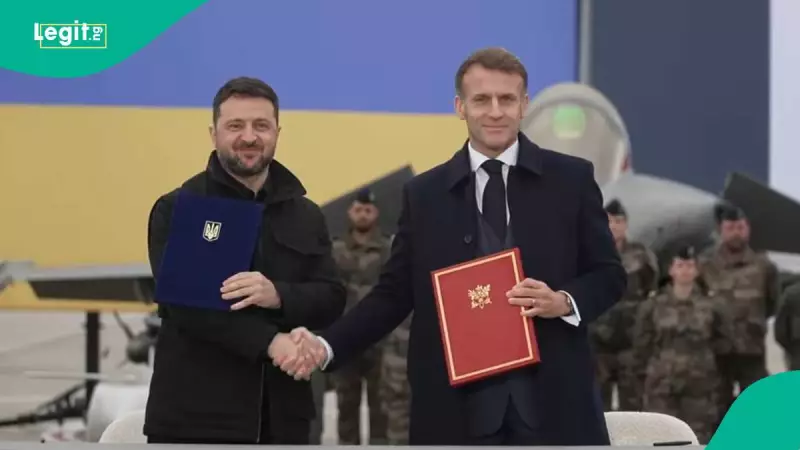
Ukrainian President Volodymyr Zelenskiy has secured a groundbreaking military agreement with France that will see Ukraine receive 100 Rafale fighter jets over the next decade, significantly boosting the country's air defence capabilities against ongoing Russian aggression.
Historic Agreement Signed in Paris
The landmark deal was announced on November 17, 2025, during President Zelenskiy's visit to Paris for crucial talks with French President Emmanuel Macron. The signing ceremony took place at Villacoublay military airport, where both leaders stood before a Rafale jet flanked by French and Ukrainian flags.
"It will be the greatest air defence, one of the world's greatest," Zelenskiy declared to journalists after signing the letter of intent with his French counterpart. The agreement comes at a critical time as Russia intensifies its drone and missile attacks on Ukrainian territory while reporting ground advances in the southeastern Zaporizhzhia region.
Comprehensive Military Support Package
The Elysee Palace confirmed that the defence package extends beyond the 100 Rafale jets to include additional critical military equipment. According to official statements, the agreement covers advanced air defence systems, bombs, and drones, with officials emphasizing that this involves new equipment rather than transfers from existing French military stocks.
President Macron described the scale of the agreement as substantial, telling LCI Television: "We're planning Rafales, 100 Rafales—that's huge. That's what's needed for the regeneration of the Ukrainian military." The French leader also noted the positive implications for France and Dassault Aviation, the manufacturer of the sophisticated fighter jets.
Financial and Training Considerations
The Elysee clarified that the signed document represents a political commitment rather than a finalized purchase contract, with a formal agreement expected to follow. Financing for this massive defence package is anticipated to involve European Union programmes and potentially utilize frozen Russian assets, though the EU has not yet reached consensus on their deployment.
Operating the advanced Rafale jets will require substantial time investment, as Ukrainian pilots must undergo rigorous training to master the sophisticated aircraft. This long-term approach reflects Ukraine's strategy to build sustainable military capacity against potential future Russian aggression.
Market Reaction and Broader Support
The announcement triggered immediate positive market response for Dassault Aviation, with shares surging 7.4% at 1137 GMT following the deal's revelation. This market enthusiasm underscores the defence industry's support for Ukraine's military strengthening efforts.
The Rafale agreement represents the culmination of weeks of negotiations about expanding French support for Ukraine's air defences. Despite facing political and budgetary constraints, Macron's government has demonstrated continued commitment to Ukraine's defence.
Last month, France had already pledged additional Mirage fighter jets beyond the six previously promised, along with a new batch of Aster 30 surface-to-air missiles for Ukraine's SAMP/T air-defence batteries.
Strategic Long-term Defence Objectives
A primary goal of the Rafale agreement is to ensure Ukraine maintains sufficient long-term military and economic support to deter future Russian aggression. In a media briefing preceding Zelenskiy's visit, Macron's office stated the intention was to "put French excellence in the arms industry at the service of Ukraine's defence" and enable Ukraine to acquire necessary systems to counter Russian aggression.
During his November 17 visit, Zelenskiy participated in a briefing with defence manufacturers including Dassault before the letter of intent signing. The day also featured a separate forum bringing together Ukrainian and French companies working in the drone sector to explore collaborative efforts.
France, alongside Britain, has been advocating for a coalition of approximately 30 countries willing to deploy troops and assets to Ukraine or its western borders once a peace agreement with Russia is established.
The comprehensive defence agreement marks a significant step in Ukraine's journey toward building a modern, capable air force that can effectively protect its sovereignty against current and future threats.




