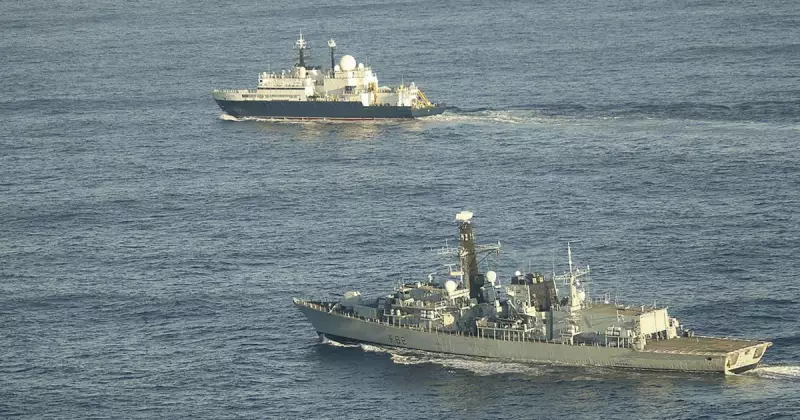
Britain's Defence Secretary John Healey has issued a strong warning to Moscow after a Russian spy vessel was detected operating dangerously close to UK territorial waters north of Scotland.
Military Response to Russian Provocation
The incident involves the Yantar, a Russian ship known for its capability to map undersea communications cables, which was spotted on the edge of UK waters for the second time this year. According to Healey, who spoke in London, the vessel's crew took what he described as a deeply dangerous step by directing lasers at Royal Air Force pilots.
In response to the threat, the UK immediately deployed a Royal Navy frigate and RAF P-8 patrol aircraft to closely monitor the Russian vessel's movements. Healey delivered a blunt message to Russia and President Vladimir Putin: We see you, we know what you're doing, and if the Yantar travels south this week we are ready.
Broader Security Threats Emerge
The Defence Secretary framed this incident as part of a wider new era of threat facing the United Kingdom and its allies. He referenced multiple security challenges including the recent brief conflict between Iran and Israel, the exposure of Chinese spies operating within Parliament, and the increasing use of drones across European airspace.
Healey argued that this evolving geopolitical landscape requires what he called an era of hard power, strong allies and sure diplomacy, insisting that Britain must significantly strengthen its defences as global adversaries become more assertive in their operations.
UK Defence Capabilities Under Scrutiny
These developments follow the publication of a damning report from the Commons Defence Committee, which concluded that the UK remains nowhere near prepared to defend itself in the event of a major conflict. Members of Parliament warned that the country lacks a comprehensive plan to protect both the homeland and its overseas territories.
The report highlighted Britain's continued heavy dependence on the United States for critical military capabilities including intelligence gathering, satellite operations, troop transport and aerial refuelling capacity. Committee chair Tan Dhesi stated that the government must confront reality, citing Russia's ongoing war in Ukraine, widespread disinformation campaigns and repeated incursions into European airspace as clear evidence that the UK cannot afford to bury our heads in the sand.
Security experts have reinforced these concerns. Dr Simon Bennett of the University of Leicester warned that the UK is sleepwalking into a bloody ambush and risks losing its sovereignty unless it adopts a more urgent defensive posture. Meanwhile, Keir Giles of Chatham House noted that while recent defence reviews have emphasized public awareness and resilience, they follow decades during which successive governments failed to properly communicate the scale of threats facing the nation.
Domestic Arms Industry Expansion
Even as these defensive shortcomings are being highlighted, the British government is preparing a major expansion of its domestic arms manufacturing capability. Healey is expected to announce progress on at least 13 potential sites for new munitions and explosives factories, with construction on the first plant scheduled to begin next year.
The Ministry of Defence has already funded feasibility studies for new facilities that would revive large-scale UK production of explosives, propellants and pyrotechnics for the first time in almost 20 years. Potential locations under consideration include Grangemouth in Scotland, Teesside in north-east England and Milford Haven in Wales, with officials estimating that the initiative could create at least 1,000 new jobs across the country.