
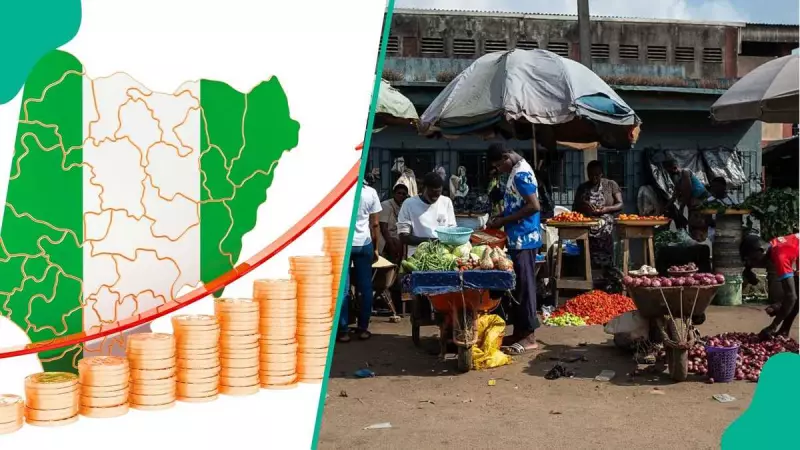
The Federation Account Allocation Committee (FAAC) has announced the distribution of a total sum of N2.94 trillion for the month of October 2025. This substantial revenue was shared among the federal government, the 36 state governments, and the 774 local government areas across Nigeria.
The official figures were confirmed in a communiqué released by the Office of the Accountant-General of the Federation, signed by its Director of Press and Public Relations, Bawa Mokwa. The announcement was made public on Wednesday, November 20, 2025, following the FAAC meeting held in the nation's capital, Abuja.
October Revenue Shows Marginal Dip
Despite the colossal figure, the October allocation of N2.094 trillion from the distributable pool represented a slight contraction compared to the previous month. The total shared revenue saw a marginal shortfall of N9 billion, which translates to a 0.43% decrease from the N2.103 trillion distributed in September 2025.
This minor decline highlights a continuing yet subtle volatility in the nation's revenue streams, even as monthly FAAC payouts consistently remain above the N2 trillion mark, a trend supported by robust oil earnings and tax inflows.
A Detailed Breakdown of the Allocation
The distributable revenue of N2.094 trillion was sourced from three main revenue streams, painting a detailed picture of the nation's earnings.
Statutory Revenue: This was the largest contributor at N1.376 trillion. It witnessed a slight improvement, with gross statutory earnings climbing to N2.164 trillion, up by N36.832 billion from September's N2.128 trillion.
Value Added Tax (VAT): VAT collections experienced a significant dip, contributing N670.303 billion. Total VAT revenue fell to N719.827 billion, a sharp decline of N152.803 billion from the N872.630 billion posted in September.
Electronic Money Transfer Levy (EMTL): This stream generated N47.870 billion for the distributable pool.
From the total gross revenue of N2.934 trillion, the sum of N115.278 billion was deducted as the cost of revenue collection. A further N724.603 billion was allocated for various transfers, interventions, refunds, and savings, leaving the N2.094 trillion for sharing.
How the Money Was Shared
The final distribution saw funds allocated to the three tiers of government and a special fund for oil-producing states.
- The Federal Government received a total of N758.405 billion.
- The 36 State Governments collectively got N689.120 billion.
- The 774 Local Government Councils were allocated N505.803 billion.
- Oil-producing states shared N141.359 billion, representing the constitutionally mandated 13% derivation from mineral revenue.
Breaking down the statutory revenue of N1.376 trillion, the Federal Government's share was N650.680 billion, states received N330.033 billion, and local governments got N254.442 billion. The N141.359 billion derivation payout was also drawn from this segment.
From the VAT pool of N670.303 billion, the Federal Government collected N100.545 billion, states received N335.152 billion, and local governments were allotted N234.606 billion. For the EMTL proceeds of N47.870 billion, the Federal Government obtained N7.180 billion, states received N23.935 billion, and local governments got N16.755 billion.
Revenue Drivers and Fiscal Concerns
The communiqué highlighted that the strong revenue performance was driven by significant increases in several key areas. These include petroleum profit tax, hydrocarbon tax, companies' income tax from upstream operations, and oil and gas royalties. Other contributors were capital gains tax, stamp duties, import duty, and excise duty.
However, this positive news is tempered by ongoing concerns over fiscal federalism. A recent report by BudgIT, the 10th edition of the State of States Report, revealed a heavy dependency on FAAC allocations by most states.
The report indicated that 29 states relied on FAAC receipts for at least half of their total revenue. Alarmingly, 28 states depended on it for at least 55% of their revenue, and 21 states relied on it for over 70%. This over-reliance creates a fiscal disincentive for states to aggressively boost their Internally Generated Revenue (IGR).
Despite record-high allocations in recent times, protests over delayed salary payments have been reported in some states. Furthermore, many states have yet to implement the new national minimum wage of N77,000, raising questions about the tangible impact of these increased revenue flows on the welfare of civil servants and the general populace.




