
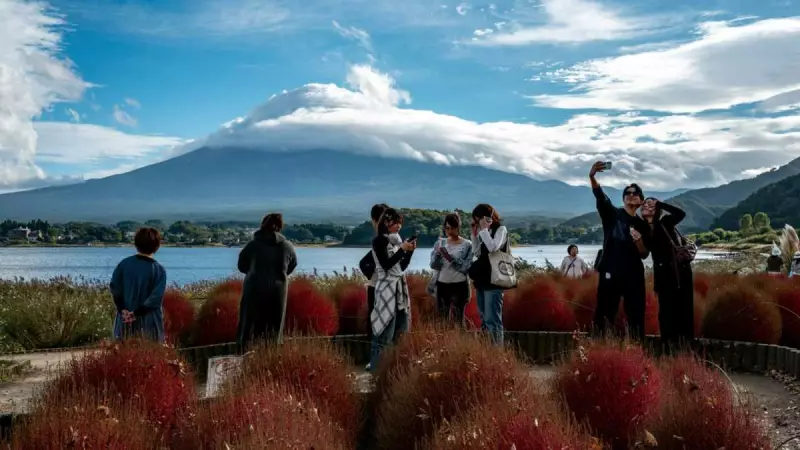
Japanese tourism and retail companies experienced significant stock market declines on Monday following China's travel advisory warning its citizens against visiting Japan. The diplomatic tension emerged from comments made by Japanese Prime Minister Sanae Takaichi concerning Taiwan's status and potential military intervention.
Economic Impact on Japanese Markets
The immediate financial consequences were severe for Japan's tourism-dependent businesses. Cosmetics giant Shiseido saw its shares plummet by almost nine percent, while department store group Takashimaya dropped by over six percent. Fast Retailing, the parent company of Uniqlo, experienced close to a six percent decline, and Japan Airlines fell by 3.9 percent.
This market reaction highlights the substantial economic relationship between the two Asian powers. According to Japan's national tourism bureau, China provided nearly 7.5 million visitors to Japan in the first nine months of 2025, making it the largest source of international tourists.
The Taiwan Controversy Escalates
The current diplomatic crisis began on November 7 when Prime Minister Takaichi suggested that Tokyo might consider military intervention in case of emergency situations involving Taiwan. The 64-year-old leader, known for her previous criticism of China's military expansion in the Asia-Pacific region, told parliament that an attack on Taiwan could constitute "a situation threatening the survival of Japan."
These remarks came shortly after what appeared to be a cordial first meeting between Takaichi and Chinese President Xi Jinping during an APEC summit in South Korea. The timing has exacerbated diplomatic tensions, leading both countries to summon each other's ambassadors last week.
Beijing responded strongly to Takaichi's comments, with the Chinese consul general in Osaka, Xue Jian, making a now-deleted social media post that threatened to "cut off that dirty neck," apparently referring to the Japanese leader.
Broader Economic Implications
The political dispute arrives at a challenging time for Japan's economy, which contracted by 0.4 percent in the third quarter according to official data released on Monday. The situation threatens to develop into a more extensive trade conflict similar to tensions experienced in the early 2010s.
Marcel Thieliant of Capital Economics warned that "the biggest risk is that China restricts exports of rare earths or imposes restrictions on Japanese exports." He particularly highlighted the vulnerability of Japanese automakers, who already face intense competition from Chinese electric vehicle manufacturers.
The financial impact of Chinese tourism is substantial, with transport ministry data showing that Chinese visitors spent 590 billion yen ($3.8 billion) in the third quarter alone, accounting for approximately 28 percent of all international tourist spending in Japan.
Japanese officials have attempted to de-escalate the situation, with Masaaki Kanai, director general of the Asian and Oceanian Affairs Bureau, traveling to China for talks with Chinese counterpart Liu Jinsong. The Japanese delegation planned to reaffirm that Takaichi's remarks don't represent a change in Japan's traditional position while protesting the Chinese diplomat's social media posts.




