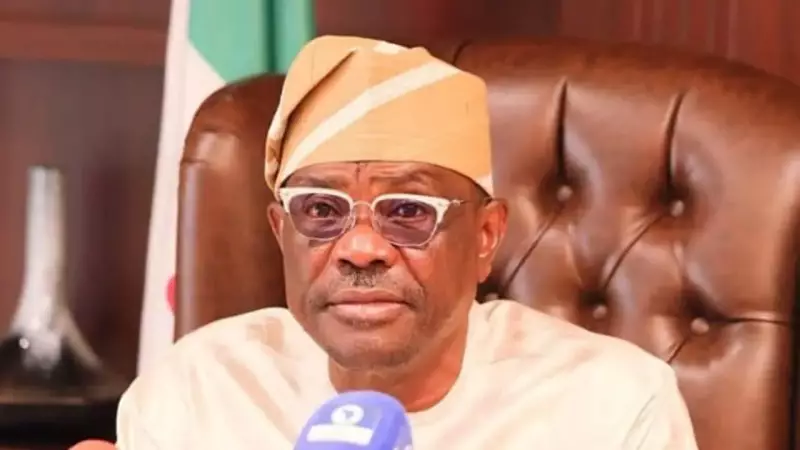
Federal Capital Territory Minister Nyesom Wike has strongly condemned recent statements by Peoples Democratic Party factional chairman Tanimu Turaki, describing claims that Nigeria's democracy faces imminent threat as reckless and misleading to the international community.
Wike's Strong Rejection of Foreign Intervention Calls
The confrontation emerged after Turaki, while addressing journalists at the PDP national secretariat in Abuja on Tuesday, November 18, 2025, alleged that Nigeria's democratic structures were under severe threat and called for foreign intervention. In an unusual appeal, the factional chairman specifically urged former US President Donald Trump and other Western leaders to intervene, claiming that genocide against Nigerian Christians was underway and accusing a serving minister of leading armed thugs against party officials.
Wike responded forcefully during a courtesy visit from the Board and Management of the newly established South-South Development Commission (SSDC) in Abuja. The minister, visibly displeased, characterized Turaki's declaration as dangerous and irresponsible political rhetoric that falsely portrayed Nigeria as unstable.
Essentially, you are telling the world this government is committing genocide. When security agencies invite you to clarify, people will shout: They want to kill him! This is a national security threat, Wike stated emphatically. He added that no individual or political actor should invite foreign powers into Nigeria's domestic politics.
SDP Raises Alarm Over Democratic Erosion
Meanwhile, Social Democratic Party National Chairman Alhaji Shehu Musa Gabam expressed grave concerns about what he described as a dangerous slide toward authoritarianism. In a strongly worded statement issued in Abuja, Gabam warned that recent events at Wadata Plaza represented not an isolated incident but a brazen display of anarchy reflecting a deeper pattern of using state institutions to suppress dissenting voices.
According to Gabam, eyewitness accounts suggest an emerging trend where state structures are allegedly deployed to intimidate political opponents, a development he cautioned could erode public trust and destabilize Nigeria's democratic system. He accused security agencies of abandoning their primary responsibility of safeguarding lives and property, alleging they were instead being used as tools to harass political rivals.
The SDP chairman also warned that Nigeria was witnessing a repeated cycle of political manipulation through abuse of constitutional processes, recalling that similar tactics were used to destabilize the SDP in the past.
INEC Rejects Wike-Backed PDP Faction's Recognition Bid
In related developments, efforts by the PDP faction led by Abdulrahman Muhammed to gain recognition from the Independent National Electoral Commission (INEC) have encountered significant obstacles. The faction, which enjoys support from Minister Wike, had made a bold attempt to cement its splinter status within the main opposition party.
Investigations revealed that the faction wrote a letter to INEC dated November 6, 2025, jointly signed by Abdulrahman Muhammed and Samuel Anyanwu as acting national chairman and secretary respectively. The letter, with reference number PDP/NS/INEC/VOL.11/008, requested postponement of the PDP state congress-cum-governorship primary for Ekiti State scheduled for November 8, 2025, citing logistical constraints.
However, INEC responded through a letter dated November 10, 2025, signed by Commission Secretary Mrs Rose Oriaran Anthony, rejecting the submission due to non-compliance with Electoral Act requirements. The commission specifically cited failure to meet provisions of part 2(12)3 of the Regulations and Guidelines for Political Parties, 2022, which mandates that the national chairman and national secretary of the party must jointly sign such notices.
The political landscape remains tense as these developments unfold, with competing narratives about the health of Nigeria's democracy and the proper role of international intervention in domestic political affairs.